Introduction
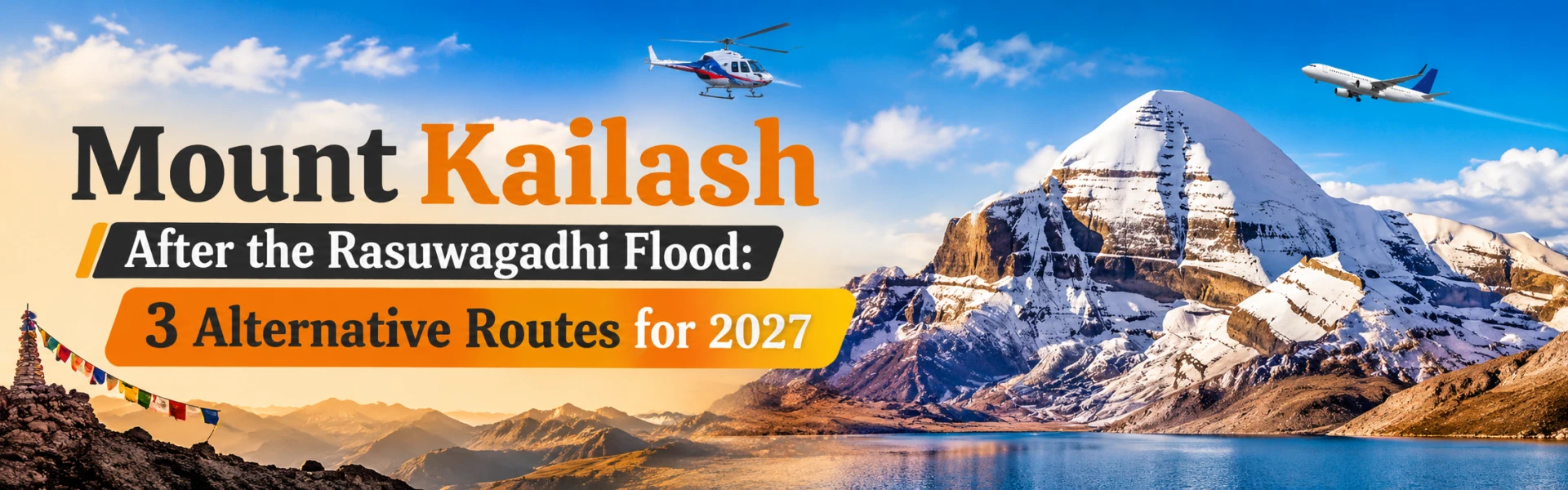
If you are searching for Mount Kailash Yatra route options for 2027, there are three practical alternative routes to reach Mount Kailash. The first route is to fly from Kathmandu to Nepalgunj and Simikot, then cross the border at Hilsa. The second route is to fly from Kathmandu to Lhasa, then continue to Mount Kailash by road or by a flight to Ngari Gunsa. The third route is to enter Tibet through mainland China, reaching Lhasa by train or flight, then continue by road or Ngari flight.
These Mount Kailash alternative routes matter because the Rasuwagadhi to Kerung border, the usual overland entry from Nepal, was hit by a flood on 26 August 2026, and as of late October there was no clear reopening date. This guide explains how to reach Mount Kailash in 2027 on each route, with realistic travel times, permits and practical tips, so you can choose the one that fits you best.
Why it is mandatory for Travellers to explore Alternative Mount Kailash Routes for 2027
Rasuwagadhi (Nepal) and Kerung, also called Gyirong (Tibet), sit at the end of the road from Kathmandu through Trishuli and Syaphrubesi. It was the usual overland entry for Kailash groups from Nepal. It also carries a large share of Nepal and China trade, so both countries try to repair it quickly.
It has now failed twice in about 14 months:
July 2025: A flash flood washed away the Friendship Bridge at the border. China built a 91 metre Bailey bridge, and traffic started again on 1 January 2026.
August 2026: A larger flood struck. Border buildings on both sides were destroyed, and so was the main bridge. Officials reported that 32 bridges and nearly 25 miles of road were lost, including the whole road from Betrawati to the border. Around 400 Kailash pilgrims were out of contact that morning.
It is important to understand that the Rasuwagadhi route has not necessarily been permanently closed. Nepalese authorities have been considering temporary bridges and road restoration. Its operating status may change before the next pilgrimage season.
For travellers planning ahead, three alternative routes are worth considering:
Via Nepalgunj and Simikot: Travel through western Nepal and enter Tibet through the Hilsa border.
Via Lhasa from Kathmandu: Fly to Lhasa and continue towards Mount Kailash by road or through a domestic flight connection.
Via China: Enter China internationally, continue to Lhasa by train or domestic flight, and travel overland to Mount Kailash.
These options provide different ways to approach the pilgrimage without depending entirely on the Rasuwagadhi crossing.
Three Alternative Routes to Mount Kailash in 2027
The following are alternative travel options for 2027, subject to border conditions, transportation availability and travel permits.
Option 1: Mount Kailash Yatra via Nepalgunj and Simikot
The Simikot and Hilsa route is an important alternative for travellers starting their Mount Kailash Yatra in Nepal. Instead of travelling north from Kathmandu through Rasuwagadhi, this route takes travellers towards western Nepal before entering Tibet through the Hilsa border in Humla district.
The journey combines domestic flights, mountain transportation and cross border travel. Depending on road conditions and helicopter availability, the section between Simikot and Hilsa can be completed using different transportation arrangements.
Proposed route
Kathmandu → Nepalgunj → Simikot → Hilsa → Purang → Lake Mansarovar → Darchen → Mount Kailash
Journey overview
Kathmandu to Nepalgunj: Take a domestic flight of approximately one hour. An overnight stay is recommended for the onward connection.
Nepalgunj to Simikot: Take a mountain flight of approximately 50 minutes to one hour. Simikot is situated at around 2,910 metres.
Simikot to Hilsa: Continue by helicopter or suitable four wheel drive transportation, depending on road conditions and availability. The helicopter journey generally takes around 30 to 40 minutes.
Hilsa to Mount Kailash: Complete border formalities and travel through Purang towards Lake Mansarovar and Darchen. The road journey from Hilsa to the Mansarovar area takes approximately four hours under favourable conditions.
Return to Kathmandu: Travel back through Hilsa and Simikot, followed by flights via Nepalgunj to Kathmandu.
Advantages of the Simikot route
Avoids dependence on the Rasuwagadhi and Kerung crossing.
Provides access to Mount Kailash through western Nepal.
Offers a relatively short connection from Hilsa to the Mansarovar region.
Allows helicopter transfers to reduce travel time between Simikot and Hilsa.
Can be suitable for travellers with limited holiday time, provided all transport connections are available.
Important considerations
The Simikot route involves high altitude travel, small aircraft and remote transportation infrastructure. Weather disruptions can affect flights, while road conditions may change during the pilgrimage season.
For travellers interested in this route, a Kailash Mansarovar Yatra from Nepal provides a useful starting point for understanding the available pilgrimage arrangements.
Option 2: Mount Kailash Yatra via Lhasa from Kathmandu
The Lhasa route is a popular alternative for reaching Mount Kailash from Nepal. It begins with a flight from Kathmandu to Lhasa, followed by a road journey across the Tibetan Plateau to Lake Mansarovar and Darchen.
Proposed route
Kathmandu → Lhasa → Shigatse → Saga → Lake Mansarovar → Darchen → Mount Kailash → Lhasa → Kathmandu
Journey overview
Kathmandu to Lhasa: Take a direct flight when available, or connect through another city. Allow time in Lhasa to adjust to the altitude, which is approximately 3,650 metres.
Lhasa to Darchen: Travel overland through the Tibetan Plateau, usually taking around 4 to 6 days depending on the itinerary and road conditions.
Lake Mansarovar and Darchen: Visit Lake Mansarovar before reaching Darchen, the starting point for the Mount Kailash Kora.
Mount Kailash Kora: The pilgrimage usually takes three days, covering approximately 52 km around the mountain.
Return to Lhasa: Travel back by road and connect to Kathmandu by flight when services are operating.
The road estimates are itinerary planning allowances, not continuous driving times. Flight times exclude airport procedures and transfers.
Why choose this route?
Direct flight access from Kathmandu to Lhasa when available.
Opportunity to explore Lhasa and its major cultural and religious sites.
A scenic overland journey across the Tibetan Plateau.
Optional flight to Ngari Gunsa to reduce road travel time.
For travellers interested in a more comfortable and organised journey, our Lhasa to Mount Kailash luxury tour provides further information about travelling from Lhasa towards the sacred mountain.
Option 3: Mount Kailash Yatra via Mainland China and Lhasa
Travellers arriving in mainland China can reach Mount Kailash through Lhasa by train or domestic flight. This route is suitable for those who want to include a visit to China before continuing across the Tibetan Plateau to Lake Mansarovar and Mount Kailash.
Proposed route:
International arrival in mainland China → Xining, Xi'an, Chengdu, Beijing or Shanghai → Lhasa → Ngari Gunsa or Darchen → Lake Mansarovar → Mount Kailash.
Journey overview
International arrival in China: Fly into a major city such as Beijing, Shanghai, Chengdu, Xi'an or Guangzhou, depending on your international connections.
Mainland China to Lhasa: Take a domestic flight to Lhasa or travel by train on the Qinghai Tibet Railway. The train journey from Xining takes approximately 20 to 21.5 hours.
Acclimatisation in Lhasa: Spend time in Lhasa to adjust to the altitude, approximately 3,650 metres, before travelling towards western Tibet.
Lhasa to Mount Kailash: Continue by road across the Tibetan Plateau, usually taking around 4 to 6 days to reach Darchen. Alternatively, take a flight to Ngari Gunsa when available, followed by a road transfer.
Lake Mansarovar and Mount Kailash: Visit Lake Mansarovar and continue to Darchen for the approximately 52 km Mount Kailash Kora, usually completed over three days.
Return journey: Travel back to Lhasa and continue to your chosen mainland Chinese city by train or flight.
Optional faster connection via Ngari Gunsa Airport
For a shorter journey from Lhasa, travellers may be able to take a domestic flight to Ngari Gunsa Airport. From there, continue by road to Darchen. The flight takes approximately 2 hours, with a further road journey of around 2.5 hours, subject to schedules and road conditions.
Why choose this route?
Convenient for travellers already visiting mainland China.
Choice of scenic train travel or faster domestic flights to Lhasa.
Opportunity to explore Chinese cities and Lhasa in one trip.
Option to reduce overland travel time through Ngari Gunsa when flights operate.
Read our Lhasa Tibet travel guide for how to prepare. Your first two days in Lhasa matter more than any other part of the trip.
From Lhasa, the road and Ngari flight choices are the same as Option 2. On the way home you take a train or flight back to the mainland and then your international flight.
Visa rules depend on you. Your nationality decides your visa. Some countries have a 30 day visa free entry to China, which was extended to 31 December 2026. Nothing confirms that it continues in 2027. Everyone still needs a Tibet Travel Permit and a guided tour with a licensed agency.
How Long Does It Take to Reach Mount Kailash Through Each Route?
These are scheduled flight and driving times. They are not door to door, and they are not the same as the number of days in a tour.
Journey Segment | Mode | Estimated time | Notes |
Kathmandu to Nepalgunj | Flight | 40 to 50 minutes | Several flights a day |
Nepalgunj to Simikot | Flight | About 45 to 60 minutes | Weather can delay it |
Simikot to Hilsa | Helicopter | 15 to 20 minutes | Road is about 95 km, 4 to 6 hours reported |
Hilsa to Darchen | Border walk and road | Walk 10 to 20 minutes, then about 5 to 6 hours | Border checks add time |
Kathmandu to Lhasa | Flight | About 1 hour 20 minutes | Himalaya Airlines in 2026 |
Lhasa to Darchen | Road | About 1,300 to 1,600 km, 20 or more hours of driving | Usually about 4 days |
Lhasa to Ngari Gunsa | Flight | About 2 hours (1 hour 50 minutes back) | Flights vary by season |
Ngari Gunsa to Darchen | Road | About 200 km, 3 hours | |
Mainland China to Lhasa | Normal speed train | Xining about 21 hours, Beijing about 40 hours | Not high speed |
Mainland China to Lhasa | Flight | Chengdu about 2 hours 15 minutes, Beijing about 4 hours 15 minutes | Nonstop flights exist |
These are my estimates of how many days it takes to reach Darchen, based on normal tour pacing. They are not promises:
Option 1: About day 3, with around 2 hours in the air plus a short helicopter flight.
Option 2 by road: About day 6 to 8, with two nights in Lhasa and about four days of driving.
Option 2 with the Ngari flight: About day 4.
Option 3: Add the mainland leg to either of the above. That is 2 to 4.5 hours by air, or 21 to 40 hours by train.
Mount Kailash Route Comparison: Which Option Is Faster?
Comparison | Option 1: Simikot | Option 2: Lhasa from Kathmandu | Option 3: Mainland China |
Starting point | Kathmandu | Kathmandu | Mainland China |
Main transportation | Flights, helicopter or jeep | International flight and road | International flight, train or domestic flight, then road |
Entry into Tibet | Hilsa | Lhasa Airport | Lhasa Airport or railway arrival |
Fastest onward connection | Simikot to Hilsa by helicopter | Lhasa to Ngari by flight | Mainland China to Lhasa by flight, then Ngari flight |
Estimated time from starting point to Darchen | Around 3 days under favourable connections | Around 5 to 7 days using Ngari flight, including Lhasa acclimatisation | Depends on Chinese arrival city and transport choice |
Scenic experience | Western Nepal and Humla landscapes | Extensive Tibetan Plateau road journey | Railway scenery and Tibetan Plateau |
Main consideration | Weather and remote mountain transport | Road journey or high altitude flight | International connections and Chinese entry requirements |
Option 1 is the fastest by number of days when the weather is good. It also has the biggest weather risk and the quickest rise in altitude. Option 2 with the Ngari flight is the fastest option that still gives your body some time to adjust. Option 2 by road is the slowest start from Nepal. Option 3 takes the longest, but it is the only choice for some travellers. The three routes are not equally easy.
Road Journey from Lhasa or Flight to Ngari Gunsa?
Travellers choosing between the Lhasa road journey and the Ngari Gunsa flight should consider more than the difference in travel time.
Both options provide access to western Tibet, but they offer very different experiences.
Factor | Lhasa to Darchen by road | Lhasa to Ngari Gunsa by flight |
Travel time | Around 4 to 6 road days | Around 2 hours by flight, then 2.5 hours by road |
Landscapes | Extensive views of the Tibetan Plateau | Aerial views during the flight |
Sightseeing | Opportunities to explore places along the route | Limited time for sightseeing en route |
Travel style | Multi day overland experience | Shorter transportation connection |
Best suited for | Travellers with more time | Travellers seeking to reduce road travel |
Altitude adjustment | Gradual exposure is possible with a well planned itinerary | Requires particular care due to high arrival altitude |
Permits, Visas and Travel Requirements for Mount Kailash in 2027
Mount Kailash is in the Ngari region of the Tibet Autonomous Region of China. International travellers must arrange their documents before they enter Tibet. Rules can change, and no official 2027 rules are published yet, so confirm each item with your operator before you pay a deposit.
Tibet Travel Permit: Foreign passport holders, overseas Chinese without a Chinese passport and Taiwan residents need this permit to enter Tibet. It is a separate document from the visa. A licensed travel agency applies for you, and you cannot apply on your own. It is checked when you board a flight into Tibet and when you enter. Travellers from visa free countries still need it.
Chinese visa: Your nationality decides this. China’s Foreign Ministry extended its 30 day visa free entry for citizens of many countries until 31 December 2026. No extension into 2027 has been announced yet. If your country is not on the list, you need a visa before you travel.
Entering Tibet from Nepal: Until recently, travellers entering from Nepal needed a special group visa from the Chinese Embassy in Kathmandu, and it replaced any other Chinese visa in the passport. Some Kathmandu operators now say this is no longer required. I could not find an official Chinese statement either way. Ask the Chinese Embassy in Kathmandu, or your operator in writing, which visa you need for your passport and dates.
Extra permits for Ngari: Remote parts of Tibet, including Ngari, can need permission beyond the Tibet Travel Permit. Your operator arranges this. Names and fees can change, so ask for the current list in writing.
Group travel: Foreign tourists cannot travel in Tibet on their own. You need a guided tour with a licensed agency.
Nepal restricted area permit: If you use the Simikot and Hilsa route, your agent must get a Nepal restricted area permit for Simikot and Hilsa. This comes from the Embassy of India’s official guidance for pilgrims.
Insurance and health: The same guidance advises insurance that covers altitude sickness, emergency treatment and evacuation. It also advises a full medical check before you go.
Best Mount Kailash Route for Different Types of Travellers
No single route suits every traveller. The right choice depends on your holiday time, nationality, budget, health, transport availability and travel interests.
Best for travellers starting in Nepal
Recommended option: Kathmandu to Nepalgunj to Simikot and Hilsa.
This route avoids the Rasuwagadhi crossing and can reach Darchen in about 3 days. Flights and helicopters must be confirmed first, and weather can cause delays.Best for travellers with limited time
Recommended option: Kathmandu to Lhasa and Ngari Gunsa by flight.
Flying to Ngari Gunsa can save about three days of driving each way. Spend at least two nights in Lhasa first, and prepare properly for high altitude.Best for a scenic Tibetan Plateau experience
Recommended option: Kathmandu to Lhasa, then the road to Darchen.
The drive suits those who enjoy road trips, photography, culture and remote mountain Scenery. Allow about four days each way.Best for travellers interested in mainland China
Recommended option: Mainland China to Lhasa by train or domestic flight.
This suits visitors who want to add a China holiday to the pilgrimage. The Qinghai Tibet Railway offers high altitude views, but it is not a high speed train, and Xining to Lhasa takes about 21 hours.
Important Travel Considerations Before Planning Your 2027 Kailash Yatra
At Thamel Travels and Tours, these are the points we ask every pilgrim to think about before booking.
Season: The yatra season usually runs from May or June to September or October. We advise avoiding full moon dates, because overbooking can leave pilgrims stranded at Simikot and Hilsa. The Saga Dawa festival also brings large crowds.
Spare days: On the Simikot and Hilsa route, weather delays can last for days because the route depends on flights and helicopters. Keep spare days before your international flight home.
Altitude: The Kailash walk is about 52 km and takes three days. Its highest point, Drolma La, is about 5,630 m. We recommend a medical check before you book and enough time in Lhasa to adjust.
Medical care and cash: Simikot and Hilsa have almost no medical facilities and no ATMs. Carry enough cash and medicine for the whole trip, plus a reserve.
Flexibility: The Rasuwagadhi situation can change before the 2027 season. Ask us whether your booking can move to another route if the border reopens or fails again.
Plan Your Mount Kailash Yatra with Thamel Travels and Tours
Thamel Travels and Tours is a Nepal based travel company. We organise Mount Kailash and Mansarovar Yatras, Tibet tours and customised trips. We help travellers understand route options, transportation connections, permits and practical arrangements before choosing a suitable itinerary.
Explore our available travel packages:
Frequently Asked Questions About Mount Kailash Routes in 2027
Is the Rasuwagadhi border route available for Mount Kailash Yatra in 2027?
The Rasuwagadhi crossing was disrupted by major flooding on August 26, 2026. As of November 2026, restoration work was being considered, but there was no definite reopening timeline. Its availability for the 2027 pilgrimage season needs to be confirmed closer to departure.
What are the alternative routes to reach Mount Kailash from Nepal?
The main alternatives are travelling through Nepalgunj, Simikot and Hilsa, or flying from Kathmandu to Lhasa and continuing towards Mount Kailash by road or domestic flight. Travellers can also enter mainland China and continue to Lhasa by train or flight.
How can I reach Mount Kailash via Simikot?
Fly from Kathmandu to Nepalgunj and then take a domestic flight to Simikot. From Simikot, continue towards Hilsa by helicopter or suitable road transportation, depending on availability. After completing border formalities, travel through Purang towards Lake Mansarovar and Darchen.
How many days does it take to reach Mount Kailash from Kathmandu via Lhasa?
A direct flight from Kathmandu to Lhasa takes approximately 1 hour and 20 minutes. Allowing for acclimatisation, travellers can reach Darchen in approximately five to seven days if using the Ngari Gunsa flight connection. The overland journey generally requires several additional days.
Can I fly from Lhasa to Ngari Gunsa Airport?
Yes. Domestic flights connect Lhasa with Ngari Gunsa Airport, subject to airline schedules and seasonal operations. The flight takes approximately two hours, followed by around 2.5 hours of road travel to Darchen.
Is travelling from Lhasa to Mount Kailash by road worth it?
Yes, particularly for travellers who enjoy scenic road journeys. The route passes through the Tibetan Plateau, remote settlements and high altitude landscapes. It provides a more extensive travel experience than flying directly to Ngari.
Can international travellers reach Lhasa by train from mainland China?
Yes. The Qinghai Tibet Railway connects mainland China with Lhasa. Xining is one of the main railway gateways, and the journey takes approximately 20 to 21.5 hours. The railway is a conventional passenger service rather than a high speed train.
Which Mount Kailash route is the fastest in 2027?
The Simikot and Hilsa route can be among the fastest options from Kathmandu when helicopter and flight connections operate smoothly. The Lhasa to Ngari Gunsa flight is another time saving option. Actual journey times depend on acclimatisation, schedules and transport availability.
What permits are required for Mount Kailash and Lake Mansarovar?
Foreign visitors generally require the appropriate Chinese entry permission, Tibet Travel Permit and additional regional authorisations for western Tibet. Travellers using the Nepal side of Hilsa may also require a Nepal Restricted Area Permit. Requirements vary according to nationality and itinerary.
Which route is most suitable for travellers starting from Nepal?
The Simikot and Hilsa route is worth considering for travellers starting in Kathmandu who want to avoid the Rasuwagadhi crossing. The Kathmandu to Lhasa flight is another practical alternative, particularly for those who prefer a choice between road travel and the Ngari Gunsa flight.