Kanchenjunga Circuit Trek, 21 DaysKanchenjunga Circuit Trek, 21 Days

Kanchenjunga Circuit Trek - 21 Days

  • Duration21 Days
  • Route Grade Exploratory Travel
  • Trip Style Restricted Area Wilderness Trek
  • Starting City Kathmandu
  • Ending City Kathmandu
Price fromUS$1575US$1850
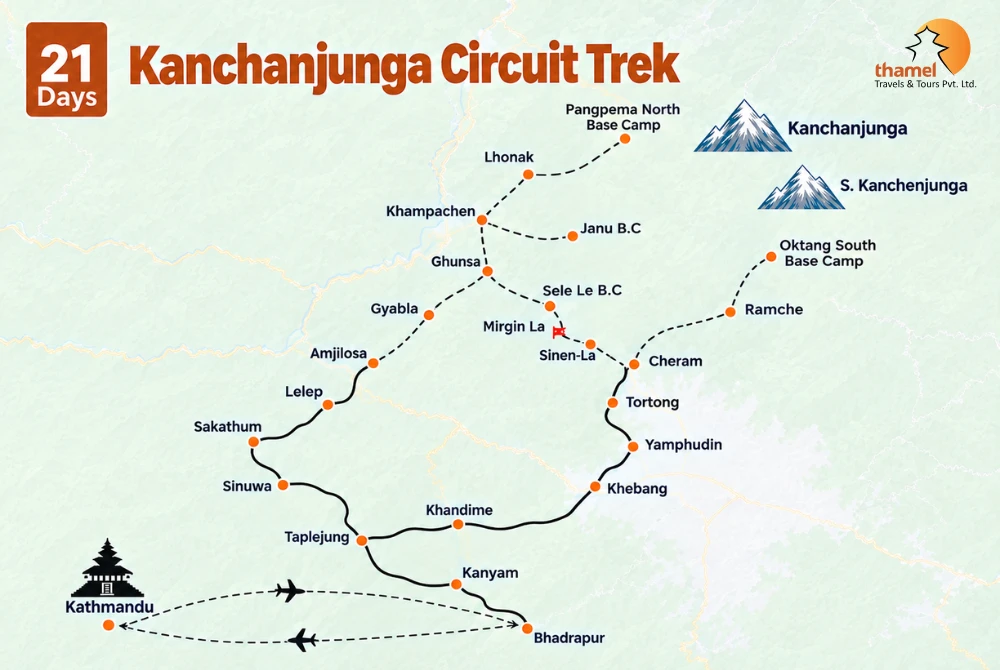
Kanchenjunga Circuit Trek - 21 Days map

Trip Overview

The Kanchenjunga Circuit Trek is less crowded and most rewarding restricted area trek. The trail makes a circle with the north and south base of Mount Kanchenjunga through the Tamor and Ghunsa valleys. Ghunsa serves as the connecting point between north base camp Pangpema and south base camp Yalung. 

As you progress on the trekking trail, it passes through Limbu and Sherpa villages with close views of a wise range of the surrounding Himalayas including Jannu, Mt Kanchenjunga. Given the date showing increased interests of the experienced trekkers, the Kanchanjunga circuit trek is going to be the hotcake of Himalayan trekking for 2027 and 2028

This 21 day itinerary begins with a flight to Bhadrapur followed by a drive to Taplejung, then follows the classic circuit route up the Tamor valley to Ghunsa, across the high country to both the north side viewpoint at Pangpema and the south side viewpoint near Ramche and Yalung, before descending through Sele La, Tortong, and Yamphudin back toward the lowlands.

The trek requires a good level of fitness and prior high altitude trekking experience, since the route spends five days above 4,000 m, and reaches 5,143 m at Pangpema. Because this is a restricted area, trekkers must travel in a group of at least two people accompanied by a licensed guide. The appropriate Restricted Area Permit and Kanchenjunga Conservation Area Permit must be arranged well in advance of departure.

Trip Detail

Information
Detail

Trip Code

KCT507N

Starting Point / End Point

Kathmandu to Kathmandu

Accommodations

3 star hotel in Kathmandu, mountain teahouses along the trekking route

Max Altitude

5,143 m at Pangpema, Kanchenjunga North Base Camp viewpoint

Duration

21 Days, 20 Nights

Country

Nepal

Trip Grade

Strenuous, a restricted area trek suitable for experienced trekkers with prior high altitude exposure

Activities

Pangpema North Base Camp viewpoint hike, Ramche and Yalung South Base Camp area visit, Sele La high pass crossing, Ghunsa acclimatization day

Season

Autumn (September to November) and Spring (March to May)

Region

Kanchenjunga region, far eastern Nepal

Transportation

Round trip flight between Kathmandu and Bhadrapur, private bus between Bhadrapur and Taplejung, trekking on foot through the Kanchenjunga region, jeep and minibus transfer from the Yamphudin area to Kanyam and on to Bhadrapur, private Hiace for airport transfers and Kathmandu sightseeing

Meals

Full board meals during the trek, breakfast in Kathmandu with welcome dinner and farewell dinner. Dinner on Day 19 and Lunch on Day 20 in Kathmandu are not included

Itinerary Overview

This 21 day, 20 night trek follows the Kanchenjunga Circuit through the Tamor valley and the Ghunsa valley, taking in both the north and south sides of the Kanchenjunga massif. You fly from Kathmandu to Bhadrapur and drive to Taplejung, then trek up through Sinuwa, Chirwa, and Lelep before reaching the Sherpa village of Ghunsa, where you spend an acclimatization day. From Ghunsa, the trail climbs through Khambachen to Lhonak, from where you take a day hike to Pangpema for views of the north face of Kanchenjunga. The route then returns to Ghunsa and crosses Sele La to reach Tseram, from where a further day hike takes you to Ramche and Yalung on the south side. The final trekking days descend through Tortong and Yamphudin before a long jeep drive to Kanyam and a return drive and flight to Kathmandu.

Here is a quick look at how your 21 day trek unfolds.

  • Day 1: Arrival in Kathmandu and trek preparation at 1,400 m

  • Day 2: Flight from Kathmandu to Bhadrapur at 90 m and drive to Taplejung at 1,820 m

  • Day 3: Trek from Taplejung to Sinuwa, 20 km, about 7 hours

  • Day 4: Trek from Sinuwa to Chirwa and Lelep at 1,750 m, 11 km, about 6 hours

  • Day 5: Trek from Lelep to Amjilosa at 2,310 m, 13 km, about 7 hours

  • Day 6: Trek from Amjilosa to Gyapla at 2,730 m, 6 km, about 4 hours

  • Day 7: Trek from Gyapla to Ghunsa at 3,595 m, 11 km, about 6 hours

  • Day 8: Acclimatization day at Ghunsa

  • Day 9: Trek from Ghunsa to Khambachen at 4,100 m, 10 km, about 6 hours

  • Day 10: Trek from Khambachen to Lhonak at 4,790 m, 10 km, about 6 hours

  • Day 11: Day hike from Lhonak to Pangpema at 5,143 m and return, 15 km round trip, about 8 hours

  • Day 12: Trek from Lhonak to Ghunsa at 3,595 m, 22 km, about 8 hours

  • Day 13: Trek from Ghunsa to Sele Le at 4,290 m, 6 km, about 4 hours

  • Day 14: Trek from Sele Le to Cheram or Tseram at 3,865 m, 11 km, about 6 hours

  • Day 15: Trek from Tseram toward Ramche and Yalung and return to Tseram, about 11 km, about 7 hours

  • Day 16: Trek from Tseram to Tortong at 2,995 m, 13 km, about 6 hours

  • Day 17: Trek from Tortong to Yamphudin at 2,080 m, 9 km, about 5 hours

  • Day 18: Short trek from Yamphudin followed by jeep and road transfer to Kanyam at 1,500 m, about 160 km, about 8 hours

  • Day 19: Drive from Kanyam to Bhadrapur at 90 m, 60 km, about 2 hours, then fly to Kathmandu at 1,350 m

  • Day 20: Half day sightseeing in Kathmandu

  • Day 21: Final departure

Kanchenjunga Circuit Trek Highlights

  • Tamor Valley Walk: The trek starts with a drive from Bhadrapur to Taplejung, followed by several days of trekking along the Tamor valley through Sinuwa, Chirwa, and Lelep, passing terraced farmland and Limbu villages before entering the Kanchenjunga Conservation Area. This lower section also offers a first look at the shift from Limbu culture in the valley to Sherpa and Tibetan influenced culture as the trail climbs higher toward Ghunsa.

  • Ghunsa, a Sherpa Village on the Circuit: The trail reaches Ghunsa at 3,595 m, a traditional Sherpa settlement with a monastery and a full acclimatization day built into the itinerary before the route continues to higher ground at Khambachen and Lhonak.

  • Pangpema, the Kanchenjunga North Base Camp: From Lhonak, a full day hike takes you to Pangpema at 5,143 m, the highest point of the trek and the site of the Kanchenjunga North Base Camp. This viewpoint offers close up views of the north face of Kanchenjunga, the world's third highest mountain, along with the surrounding icefall and glacier.

  • Sele La and the High Pass Complex: After returning to Ghunsa, the route climbs to Sele Le at 4,290 m before continuing across a stretch of connected high passes, joining the northern and southern sides of the circuit. This section is regarded as one of the more demanding parts of the trek.

  • Ramche and Yalung, the South Side Views: From Tseram, a day hike leads to Ramche and on to Yalung at 4,730 m, an area also known as the Oktang Viewpoint, offering views of the south face of Kanchenjunga from the Yalung glacier.

  • Jannu and the Surrounding Peaks: Throughout the higher stretches of the trek, particularly around Khambachen, Lhonak, and the Yalung side, the route offers views of Jannu along with other major peaks of the Kanchenjunga massif.

  • Rich Alpine Flora and Fauna: The Kanchenjunga Conservation Area protects a wide range of wildlife and plant life along the trek, with forests of pine and rhododendron giving way to orchids, lilies, and other alpine flora at higher elevation. The region is also home to species such as the red panda, musk deer, Himalayan black bear, and snow leopard, along with a wide variety of alpine birds.

  • Yamphudin and the Return Journey: The final trekking days descend through Tortong and Yamphudin, after which a long jeep drive through village roads and the Mechi Highway brings you to Kanyam, an area known in the region for its tea gardens, before the drive to Bhadrapur and the flight back to Kathmandu.

Altitude and Activities
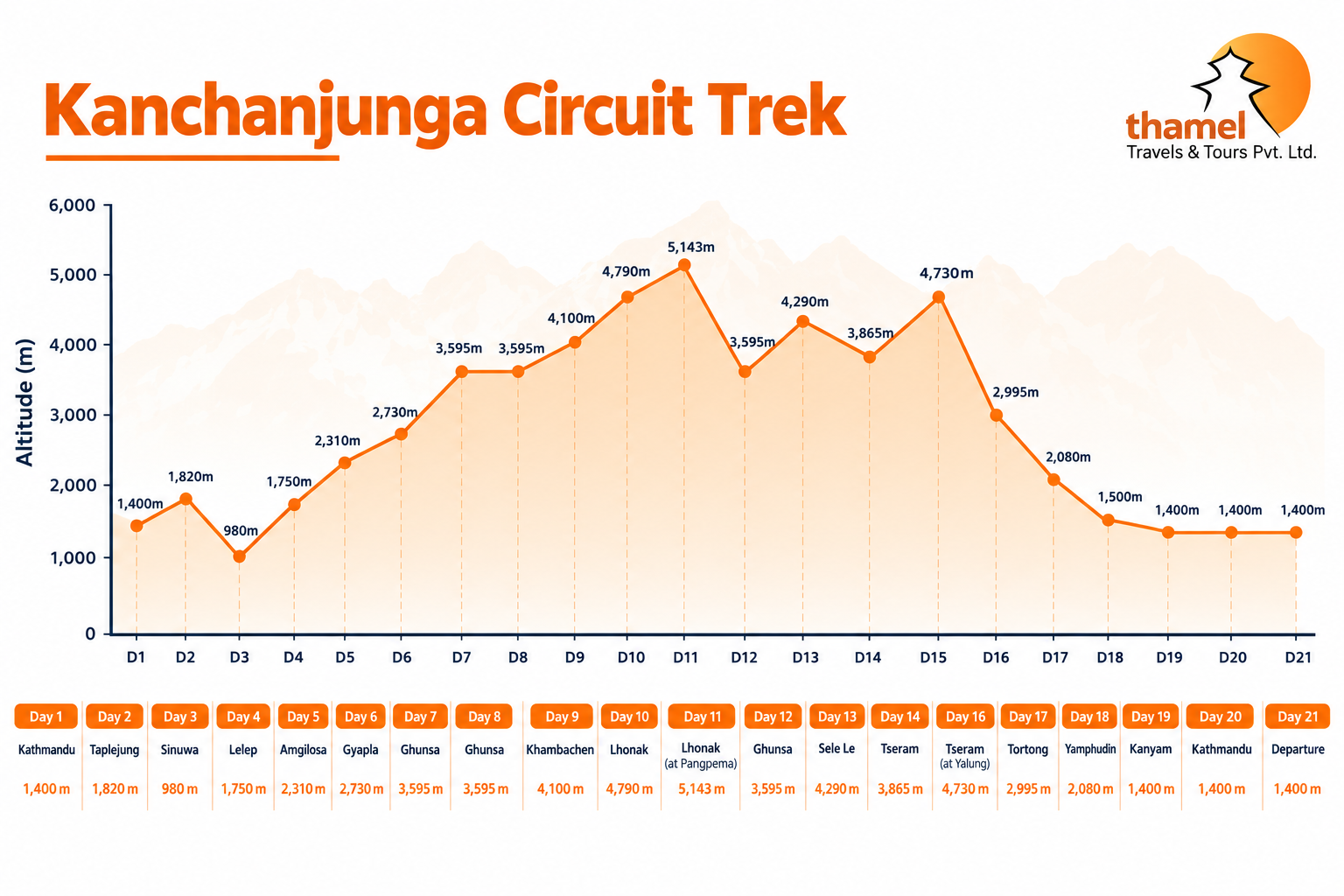
The trek begins at Kathmandu before a flight to Bhadrapur at 90 m and a drive to Taplejung at 1,820 m. From Taplejung, the trail climbs steadily through the Tamor valley to Ghunsa at 3,595 m, where an acclimatization day is spent before the route continues to Khambachen and Lhonak. From Lhonak, a day hike reaches Pangpema at 5,143 m, the highest point of the trek, before the route returns to Ghunsa and crosses Sele La to reach Tseram, from where a further day hike reaches Ramche and Yalung on the south side. The trek then descends through Tortong and Yamphudin before the long road journey back toward Kathmandu.

Day
Location
Altitude
Activities
Travel Time

Day 1

Kathmandu

1,400 m

Arrival and trek preparation

Airport transfer

Day 2

Taplejung

1,820 m

Flight to Bhadrapur, drive to Taplejung

About 1 hour flight and 3 to 4 hours drive

Day 3

Sinuwa

980 m 

Trek through the lower Tamor valley

About 7 hours

Day 4

Lelep

1,750 m

Trek via Chirwa along the Tamor valley

About 6 hours

Day 5

Amgilosa

2,310 m

Trek toward the Ghunsa valley

About 7 hours

Day 6

Gyapla

2,730 m

Trek through forested valley

About 4 hours

Day 7

Ghunsa

3,595 m

Trek to the Sherpa village of Ghunsa

About 6 hours

Day 8

Ghunsa

3,595 m

Acclimatization day, optional short walks

Free day

Day 9

Khambachen

4,100 m

Trek into the high alpine zone

About 6 hours

Day 10

Lhonak

4,790 m

Trek to the base of the Pangpema hike

About 6 hours

Day 11

Lhonak

5,143 m at Pangpema

Day hike to Pangpema North Base Camp and return

About 8 hours round trip

Day 12

Ghunsa

3,595 m

Return trek to Ghunsa

About 8 hours

Day 13

Sele Le

4,290 m

Trek toward the Sele La crossing

About 4 hours

Day 14

Tseram

3,865 m

Trek across Sele La and down to Tseram

About 6 hours

Day 15

Tseram

4,730 m at Yalung

Day hike to Ramche and Yalung and return to Tseram

About 7 hours round trip

Day 16

Tortong

2,995 m

Trek down the Simbuwa valley

About 6 hours

Day 17

Yamphudin

2,080 m

Trek to the village of Yamphudin

About 5 hours

Day 18

Kanyam

1,500 m

Short trek followed by jeep drive via the Mechi Highway

About 8 hours drive

Day 19

Kathmandu

1,400 m

Drive to Bhadrapur, fly back to Kathmandu

About 2 hours drive and 1 hour flight

Day 20

Kathmandu

1,400 m

Half day sightseeing

About 3 to 4 hours

Day 21

Departure

1,400 m

Final departure

Airport transfer

Accommodation and Meals

You will stay in a comfortable 3 star hotel in Kathmandu and in mountain teahouses throughout the trekking portion of the journey. Full board meals consisting of breakfast, lunch, and dinner are provided during the trek. In Kathmandu, breakfast is included throughout, with a welcome dinner on arrival and a farewell dinner on Day 20. Dinner on Day 19 and lunch on Day 20 in Kathmandu are not included.

Day
Location
Accommodation
Breakfast
Lunch
Dinner

Day 1

Kathmandu

3 star hotel

N/A

N/A

Welcome Dinner

Day 2

Taplejung

Teahouse

Included

Included

Included

Day 3

Sinuwa

Teahouse

Included

Included

Included

Day 4

Lelep

Teahouse

Included

Included

Included

Day 5

Amgilosa

Teahouse

Included

Included

Included

Day 6

Gyapla

Teahouse

Included

Included

Included

Day 7

Ghunsa

Teahouse

Included

Included

Included

Day 8

Ghunsa

Teahouse

Included

Included

Included

Day 9

Khambachen

Teahouse

Included

Included

Included

Day 10

Lhonak

Teahouse

Included

Included

Included

Day 11

Lhonak

Teahouse

Included

Included

Included

Day 12

Ghunsa

Teahouse

Included

Included

Included

Day 13

Sele Le

Teahouse

Included

Included

Included

Day 14

Tseram

Teahouse

Included

Included

Included

Day 15

Tseram

Teahouse

Included

Included

Included

Day 16

Tortong

Teahouse

Included

Included

Included

Day 17

Yamphudin

Teahouse

Included

Included

Included

Day 18

Kanyam

Teahouse or local lodge

Included

Included

Included

Day 19

Kathmandu

3 star hotel

Included

Included

Not Included

Day 20

Kathmandu

3 star hotel

Included

Not Included

Farewell Dinner

Day 21

Departure

N/A

Included

N/A

N/A

Cost Includes

Cost and Inclusions

This 21 day trek includes accommodation in a 3 star hotel in Kathmandu and mountain teahouses during the trekking route, along with the required restricted area permits, flights between Kathmandu and Bhadrapur, ground transportation, an experienced trekking team, and full board meals during the trek. The table below outlines everything included in your package, along with the items you will need to arrange separately.

Cost Includes
Cost Excludes

20 nights accommodation including breakfast, lunch, and dinner, with 3 star hotels in Kathmandu and mountain teahouses along the trek

International airfare to and from Nepal

Welcome dinner and farewell dinner

Nepal entry visa fee

Trekking permits, including the Restricted Area Permit and the Kanchenjunga Conservation Area Permit

Travel insurance

Kathmandu to Bhadrapur to Kathmandu round trip flights

One dinner and one lunch in Kathmandu, on Day 19 and Day 20

All airport transfers by private Hiace

Boiled water, hot water shower, local wifi charges, and mobile charging fees during the trek

Bhadrapur to Taplejung transfer by private bus

Any extra or particular meal orders during the trek outside the set menu

Transfers from the Yamphudin area to Kanyam by jeep and minibus as required, and Kanyam to Bhadrapur by minibus

Tips for the guide and porters

Private Hiace for Kathmandu sightseeing

Personal expenses such as drinks, snacks, and phone calls

Duffle bag, trekking poles, and a new sleeping bag for each trekker


One SIM card with unlimited data for each trekker


A trekking team of 7 staff, including 1 guide, 1 assistant guide, and 5 porters, with an additional porter available for USD 270 extra

 
Itinerary

Welcome to Nepal. Once you land at Tribhuvan International Airport, our representative will be waiting outside the arrival terminal with our company name and logo board. They will take you to your hotel in Kathmandu, where you can check in and rest after your flight. In the evening, our guide will meet you for a briefing about the Kanchenjunga Circuit ahead, followed by a welcome dinner where you can meet the rest of your team.

  • Route: Tribhuvan International Airport to Hotel in Kathmandu

  • Altitude: 1,400 m

  • Accommodation: 3 star hotel

  • Meals: Welcome Dinner

  • Highlights: Arrival in Nepal, airport pickup, hotel check in, trek briefing with your guide

    After an early breakfast, you take a short domestic flight from Kathmandu to Bhadrapur, a town in the flat lowlands of Jhapa district. From the airport, a private vehicle picks you up for the drive north toward Taplejung. The road climbs out of the plains through Ilam district, passing tea estates around Kanyam before winding further into the hills. By late afternoon, you reach Taplejung bazaar, the district headquarters and the starting point of the trek.

    • Route: Kathmandu to Bhadrapur by flight, then Bhadrapur to Taplejung by private vehicle via Ilam and Kanyam

    • Altitude: 90 m at Bhadrapur, rising to 1,820 m at Taplejung

    • Accommodation: Teahouse

    • Meals: Breakfast, lunch, and dinner

    • Highlights: Flight over the eastern lowlands, drive through the Ilam tea gardens, arrival in Taplejung bazaar

      Leaving Taplejung bazaar, the trail descends toward the Tamor River and follows its course through the villages of Sinam and Mitlung before continuing on to Sinuwa. Along the way, you pass terraced fields and Limbu settlements typical of the lower Tamor valley.

      • Route: Taplejung to Sinuwa via Sinam and Mitlung along the Tamor River

      • Altitude: Elevation not confirmed

      • Accommodation: Teahouse

      • Meals: Breakfast, lunch, and dinner

      • Highlights: First day of trekking, walking through Sinam and Mitlung villages, following the Tamor River

        From Sinuwa, the trail continues along the Tamor valley to the village of Chirwa, where the route crosses to the true left bank of the river. From Chirwa, the path continues upstream to Lelep, the checkpoint village where permits are verified before entering the core of the Kanchenjunga Conservation Area.

        • Route: Sinuwa to Lelep via Chirwa along the Tamor River

        • Altitude: 1,750 m

        • Accommodation: Teahouse

        • Meals: Breakfast, lunch, and dinner

        • Highlights: Crossing the Tamor River at Chirwa, permit checkpoint at Lelep, entering the Kanchenjunga Conservation Area

          From Lelep, the trail leaves the Tamor valley and turns north along the Ghunsa Khola. The path climbs steeply through forest, crossing suspension bridges over the Ghunsa Khola, before reaching Amjilosa, a small settlement perched on a ridge above the river.

          • Route: Lelep to Amjilosa along the Ghunsa Khola

          • Altitude: 2,310 m

          • Accommodation: Teahouse

          • Meals: Breakfast, lunch, and dinner

          • Highlights: Steep climb beside the Ghunsa Khola, crossing suspension bridges, arrival at the ridge top village of Amjilosa

            The trail from Amjilosa continues north along the Ghunsa Khola through quiet forest, passing the small settlement of Solima before reaching Gyapla. This is a shorter walking day, giving your body more time to adjust to the steady altitude gain.

            • Route: Amjilosa to Gyapla via Solima

            • Altitude: 2,730 m

            • Accommodation: Teahouse

            • Meals: Breakfast, lunch, and dinner

            • Highlights: Forest walking beside the Ghunsa Khola, passing through Solima, shorter trekking day

              From Gyapla, the trail climbs steadily through forest toward Ghunsa, the largest Sherpa village on this side of the circuit. As the valley opens up near the village, you get your first clear views of the peaks surrounding the upper Ghunsa valley. Ghunsa has a monastery, known locally as Ghunsa Gompa, and is also where you will rest for an extra day.

              • Route: Gyapla to Ghunsa

              • Altitude: 3,595 m

              • Accommodation: Teahouse

              • Meals: Breakfast, lunch, and dinner

              • Highlights: Arrival in the Sherpa village of Ghunsa, visit to Ghunsa Gompa monastery, first open mountain views

                Today is a full rest day in Ghunsa. Rather than staying in bed, a short walk up toward the ridge above the village, or a visit to Ghunsa Gompa, helps your body adjust faster to the altitude before the trail climbs toward Khambachen and Lhonak. You will sleep in the same teahouse again tonight.

                • Route: Rest day around Ghunsa village

                • Altitude: 3,595 m

                • Accommodation: Teahouse

                • Meals: Breakfast, lunch, and dinner

                • Highlights: Rest and acclimatization, optional walk above the village, visit to Ghunsa Gompa

                  Leaving Ghunsa, the trail follows the Ghunsa Khola upstream past the small settlement of Phole, a village known for its Tibetan refugee carpet weaving center, and on to Ramthang before reaching Khambachen. As the trees thin out, you get close views of Jannu, also known as Kumbhakarna, rising sharply above the valley.

                  • Route: Ghunsa to Khambachen via Phole and Ramthang

                  • Altitude: 4,100 m

                  • Accommodation: Teahouse

                  • Meals: Breakfast, lunch, and dinner

                  • Highlights: Passing the Tibetan settlement of Phole, close views of Jannu (Kumbhakarna), arrival in Khambachen

                    From Khambachen, the trail crosses more open, rocky terrain along the edge of the Kanchenjunga glacier's moraine, passing the seasonal herding spot of Ramtang before reaching Lhonak. Lhonak sits in a wide glacial valley and serves as the base camp village for tomorrow's hike up to Pangpema.

                    • Route: Khambachen to Lhonak along the Kanchenjunga glacier moraine

                    • Altitude: 4,790 m

                    • Accommodation: Teahouse

                    • Meals: Breakfast, lunch, and dinner

                    • Highlights: Walking along the glacial moraine, wide views of the upper Kanchenjunga valley, arrival in Lhonak

                      This is the highlight of the northern side of the trek. From Lhonak, the trail follows the edge of the Kanchenjunga glacier up to Pangpema, the site of the Kanchenjunga North Base Camp. From this viewpoint, you look directly onto the north face of Kanchenjunga and the icefall below it. After spending time at Pangpema, you retrace the same trail back down to Lhonak for the night.

                      • Route: Lhonak to Pangpema (Kanchenjunga North Base Camp) and back to Lhonak

                      • Altitude: 5,143 m at Pangpema

                      • Accommodation: Teahouse

                      • Meals: Breakfast, lunch, and dinner

                      • Highlights: Reaching Pangpema, the highest point of the trek, direct views of the north face of Kanchenjunga and its icefall

                        Today you retrace the trail from Lhonak back down through Ramtang and Khambachen to Ghunsa. It is a long day in terms of distance, but since most of the walking is downhill, it feels less demanding than the climb up.

                        • Route: Lhonak to Ghunsa via Khambachen and Ramtang

                        • Altitude: 3,595 m

                        • Accommodation: Teahouse

                        • Meals: Breakfast, lunch, and dinner

                        • Highlights: Long descent back through the upper Ghunsa valley, return to Ghunsa village

                          From Ghunsa, the trail leaves the main valley and climbs steeply through forest and rhododendron cover up to Sele Le, also called Selele Kharka, a high open grazing area used as the base for crossing the pass complex the next day.

                          • Route: Ghunsa to Sele Le (Selele Kharka)

                          • Altitude: 4,290 m

                          • Accommodation: Teahouse

                          • Meals: Breakfast, lunch, and dinner

                          • Highlights: Steep climb out of the Ghunsa valley through rhododendron forest, arrival at the high pastures of Sele Le

                            Today's route crosses a chain of high passes, generally known as Sele La, Mirgin La, and Sinion La, which together link the northern side of the circuit to the southern side near Kanchenjunga. The trail rises and falls across several ridgelines with wide mountain views before dropping down to Tseram, also called Cheram.

                            • Route: Sele Le across Sele La, Mirgin La, and Sinion La to Tseram

                            • Altitude: 3,865 m

                            • Accommodation: Teahouse

                            • Meals: Breakfast, lunch, and dinner

                            • Highlights: Crossing the Sele La, Mirgin La, and Sinion La pass complex, wide ridge top views, arrival in Tseram

                              From Tseram, the trail climbs to Ramche, where you stop for lunch, then continues to Yalung near the Yalung glacier. This area is home to the Oktang Viewpoint, one of the best spots to take in the full south face of Kanchenjunga. After enjoying the views at Oktang, you return to Tseram for the night.

                              • Route: Tseram to Ramche and Yalung (Oktang Viewpoint), then back to Tseram

                              • Altitude: 4,580 m at Ramche, 4,730 m at Yalung and the Oktang Viewpoint

                              • Accommodation: Teahouse

                              • Meals: Breakfast, lunch, and dinner

                              • Highlights: Lunch stop at Ramche, views of the Kanchenjunga south face from the Oktang Viewpoint near Yalung

                                Leaving Tseram, the trail descends along the Simbuwa Khola valley through forest toward Tortong. As you drop in altitude, the vegetation thickens again and the trail becomes noticeably warmer.

                                • Route: Tseram to Tortong along the Simbuwa Khola

                                • Altitude: 2,995 m

                                • Accommodation: Teahouse

                                • Meals: Breakfast, lunch, and dinner

                                • Highlights: Descent through the Simbuwa Khola valley, return to forested, lower altitude terrain

                                  The trail continues downhill from Tortong through forest and farmland to Yamphudin, a village home to Limbu and Rai communities. Yamphudin marks the end of the main trekking route through the Kanchenjunga Conservation Area.

                                  • Route: Tortong to Yamphudin

                                  • Altitude: 2,080 m

                                  • Accommodation: Teahouse

                                  • Meals: Breakfast, lunch, and dinner

                                  • Highlights: Descent through farmland, arrival in the Limbu and Rai village of Yamphudin

                                    After breakfast, you walk for about an hour from Yamphudin to the roadhead, where a private jeep is waiting. From there, the drive follows village roads through Khebang before joining the Mechi Highway for the journey to Kanyam, an area known for its tea gardens in Ilam district.

                                    • Route: Yamphudin on foot to the roadhead, then by jeep via Khebang and the Mechi Highway to Kanyam

                                    • Altitude: 1,500 m

                                    • Accommodation: Teahouse or local lodge

                                    • Meals: Breakfast, lunch, and dinner

                                    • Highlights: Final walking stretch to the roadhead, drive through Khebang, arrival in the Kanyam tea gardens

                                      A private vehicle takes you from Kanyam down through Ilam to Bhadrapur. From there, you board a flight back to Kathmandu. Dinner this evening in Kathmandu is not included, so you are free to choose where to eat.

                                      • Route: Kanyam to Bhadrapur by road via Ilam, then Bhadrapur to Kathmandu by flight

                                      • Altitude: 90 m at Bhadrapur, 1,400 m at Kathmandu

                                      • Accommodation: 3 star hotel

                                      • Meals: Breakfast and lunch

                                      • Highlights: Drive through Ilam district, flight back to Kathmandu

                                        With some free time in Kathmandu, your guide takes you on a half day sightseeing tour covering sites such as Swayambhunath, known locally as the Monkey Temple, and Boudhanath Stupa, one of the largest Buddhist stupas in the world. Lunch today is not included, but in the evening the whole group gathers for a farewell dinner to celebrate finishing the Kanchenjunga Circuit together.

                                        • Route: Half day sightseeing tour covering Swayambhunath and Boudhanath Stupa in Kathmandu

                                        • Altitude: 1,400 m

                                        • Accommodation: 3 star hotel

                                        • Meals: Breakfast and Farewell Dinner

                                        • Highlights: Sightseeing at Swayambhunath and Boudhanath Stupa, farewell dinner with the group

                                          On your last day, after breakfast at the hotel, our representative will take you to Tribhuvan International Airport in good time for your international flight home. This brings your Kanchenjunga Circuit Trek to an end.

                                          • Route: Hotel in Kathmandu to Tribhuvan International Airport

                                          • Altitude: 1,400 m

                                          • Meals: Breakfast

                                          • Highlights: Airport transfer and final departure from Nepal

                                            Trip Information

                                            Know Before You Book

                                            • Visa Requirements: All citizens of the world except Indian passport holders need a visa to enter Nepal, and most travellers can obtain a Visa on Arrival at Tribhuvan International Airport. Since this is a 21 day trip through a remote restricted region where road and flight delays are common, we recommend applying for a 30 day tourist visa, which costs USD 50, to give yourself a comfortable buffer around your travel dates. You can apply and pay online in advance at https://nepaliport-new.immigration.gov.np/

                                            • Passport Validity: Please ensure your passport is valid for at least six months from your arrival date, with at least one blank page for your visa stamp.

                                            • Restricted Area Permit: The Kanchenjunga region is classified as a restricted area by the Government of Nepal. Trekkers must obtain a Restricted Area Permit along with the Kanchenjunga Conservation Area Permit before starting the trek. Restricted area rules require trekkers to travel in a group of at least two people, accompanied at all times by a licensed guide. We arrange both permits on your behalf as part of this package, but we will need your passport details and passport sized photographs well in advance of your arrival date.

                                            • Fitness Level: This trek reaches 5,143 m at Pangpema and spends many consecutive days above 4,000 m, including the multi day pass crossing from Sele Le to Tseram. Trekkers should have a good level of fitness, along with prior high altitude trekking experience, and should begin a regular walking or hiking routine several months before departure.

                                            • Group and Guide Requirements: As a restricted area, this trek requires a licensed guide throughout the trip, along with the minimum group size set by the permit regulations. Our itinerary includes a dedicated guide, an assistant guide, and a team of porters to support the group across the more remote sections of the route.

                                            • Travel Insurance: Travel insurance covering medical emergencies, high altitude evacuation, and trip delays is strongly recommended for this trek, given the remoteness of the Kanchenjunga region and the limited access to rescue services along much of the route. Please confirm that your policy covers trekking above 5,000 m.

                                            • Currency and Payment Methods: We accept payments in major currencies such as USD, EUR, and GBP. It is a good idea to carry some Nepali Rupees in smaller denominations for personal expenses along the trek, since ATMs and card payment facilities are not available once you leave Taplejung.

                                            • Booking and Advance Preparation: Because this is a restricted area trek requiring government permits, we recommend booking and sending your documents at least four weeks before your planned departure date, to allow enough time for permit processing.
                                               

                                            Accommodations, Meals and Transportation

                                            • Typical Accommodation Used: You will stay in a comfortable 3 star hotel in Kathmandu before and after the trek. During the trekking portion of the journey, you will stay in mountain teahouses, which offer simple twin rooms and a shared dining hall where meals are served. Facilities become more basic the higher you go, particularly from Ghunsa onward, so it helps to set realistic expectations for hot showers and charging facilities in the upper villages.

                                            • Meals: Breakfast is included throughout your time in Kathmandu, along with a welcome dinner on Day 1 and a farewell dinner on Day 20. During the trek, full board meals of breakfast, lunch, and dinner are included at every stop from Taplejung through Kanyam. Dinner on Day 19 and lunch on Day 20 in Kathmandu are not included, giving you the freedom to choose a restaurant of your liking on those occasions.

                                            • Guide Support: An experienced guide and an assistant guide accompany you throughout the trek, assisting with permit checks at the various checkpoints, acclimatization pacing, and navigation across remote sections such as the Sele La, Mirgin La, and Sinion La pass complex and the approach to Pangpema. A team of five porters is included to carry your duffle bags, so you only need to manage a light daypack during the trekking days.

                                            • Transportation: This package includes private airport transfers in Kathmandu, round trip flights between Kathmandu and Bhadrapur, a private bus transfer between Bhadrapur and Taplejung, jeep and minibus transfers from the Yamphudin area to Kanyam and on to Bhadrapur, and a private Hiace for your half day Kathmandu sightseeing tour. All movement between villages on the trekking portion of the trip is done on foot.

                                            • Communication: A SIM card with unlimited data is provided for each trekker, giving you basic connectivity in areas with network coverage. Coverage becomes unreliable or unavailable in the more remote sections around Khambachen, Lhonak, and the high pass crossing, so it is best to let family or contacts know that communication may be limited during those days.
                                               

                                            Seasonal and Weather Updates

                                            • Autumn (September to November): This is a popular season for the Kanchenjunga Circuit, with generally stable weather, clear skies, and good mountain visibility from viewpoints such as Pangpema and the Oktang Viewpoint near Yalung. Nights at higher elevation, particularly around Lhonak and along the Sele La pass complex, are very cold, often well below freezing.

                                            • Spring (March to May): Spring brings milder daytime temperatures at lower elevation along the Tamor and Ghunsa valleys, along with rhododendron forests in bloom between Ghunsa and Sele Le. Mountain views are generally good, though afternoon cloud can build up more quickly than in autumn.

                                            • Winter and Monsoon: Winter months bring heavy snowfall at higher elevations, which can make the pass crossing between Sele Le and Tseram difficult or impassable, while the monsoon season brings heavy rain, leech activity in the lower forested sections, and a higher chance of flight delays between Kathmandu and Bhadrapur. We generally do not recommend this trek during the peak monsoon months.
                                               

                                            Health and Safety

                                            • General Wellbeing: This trek spends many days above 4,000 m and reaches 5,143 m at Pangpema, with a further high point along the Sele La, Mirgin La, and Sinion La pass crossing. Trekkers should be aware of the signs of altitude sickness, including headache, nausea, and dizziness, and should communicate any symptoms to their guide immediately rather than pushing through them.

                                            • Healthcare Facilities: Healthcare facilities along the Kanchenjunga route are very limited. Basic health posts exist in larger villages such as Ghunsa, while full hospital facilities are only available in Taplejung and Kathmandu. In the event of a serious medical issue at higher elevation, helicopter evacuation may be necessary, which is why comprehensive travel insurance is essential for this trek.

                                            • Pacing: Walking at a comfortable, steady pace and making full use of the acclimatization day at Ghunsa on Day 8 helps your body adjust before the trail continues to Khambachen, Lhonak, and Pangpema. Our guides are trained to monitor the group closely and to adjust the daily pace if needed.

                                            • Hydration: Drink sufficient fluids throughout the trekking days, especially at higher altitude around Lhonak, Pangpema, and the Sele La pass complex, where dehydration can worsen the effects of altitude.

                                            • Weather Awareness: Weather in the Kanchenjunga region can change quickly, particularly around the high pass crossing and at Pangpema. Your guide will monitor conditions closely and may adjust timing or, in rare cases, the itinerary itself to keep the group safe.
                                               

                                            Packing Checklist

                                            • Essential Clothing: Comfortable layered clothing suitable for trekking, including a warm down jacket for cold mornings, evenings, and the higher sections of the route around Lhonak, Pangpema, and the Sele La pass complex.

                                            • Footwear: Sturdy trekking boots with good ankle support and grip, suitable for many consecutive days of walking on varied and high altitude terrain, including rocky moraine sections near Pangpema and the ridge trail across Sele La.

                                            • Trail Gear: A sun hat, sunglasses, sunscreen, and a light rain jacket for changing weather, along with the trekking poles provided as part of your package.

                                            • Personal Items: A small daypack, reusable water bottle, personal toiletries, a camera, and any personal medications you need, along with the duffle bag and sleeping bag provided as part of your package.

                                            • Extras for This Trek: Since parts of the route, particularly above Ghunsa, have very limited shops or resupply points, it is worth carrying a few extra snacks, a headlamp with spare batteries, and cash in small denominations for the trekking portion of the journey.
                                               

                                            Important Notices

                                            • Travel Advisories: Before you travel, we recommend checking the latest travel advice issued by your home country. Our team is happy to provide local updates on trail and permit conditions before your trip.

                                            • Remote Terrain: This is one of the more remote treks in Nepal, particularly the sections around Khambachen, Lhonak, Pangpema, and the Sele La, Mirgin La, and Sinion La pass complex, with very limited facilities such as shops, ATMs, and communication networks. Plan accordingly and carry sufficient cash for the entire trekking portion of your trip.

                                            • Restricted Area Compliance: As this is a restricted area, please carry your passport with you at all times during the trek, since permit checks take place at several points along the route, including at Lelep.

                                            • Responsible Travel: We encourage you to respect local customs, ask permission before photographing monks and local families, and support the local economy of the Taplejung and Kanchenjunga region, including the teahouses and communities you pass through, during your trek.

                                            Trip Preparations
                                            • What is the highest point of the Kanchenjunga Circuit Trek?

                                              The highest point is Pangpema, the Kanchenjunga North Base Camp viewpoint, at 5,143 m, reached on the Day 11 hike from Lhonak.

                                            • Yes. The Kanchenjunga region is a restricted area, so trekkers must obtain a Restricted Area Permit along with the Kanchenjunga Conservation Area Permit, and must travel in a group of at least two people with a licensed guide at all times.

                                            • Yes. The itinerary includes a day hike to Pangpema on the north side on Day 11, and a separate day hike to Ramche and Yalung, near the Oktang Viewpoint, on the south side on Day 15.

                                            • Yes. A full acclimatization day is included at Ghunsa on Day 8, before the trail continues to higher elevations at Khambachen and Lhonak, and the pace of ascent from there follows a gradual, staged climb.

                                            • This is a long, remote, restricted area trek that spends many consecutive days above 4,000 m, reaches above 5,000 m at Pangpema, and includes a demanding multi day pass crossing between Sele Le and Tseram. It is considered more strenuous than popular treks such as the Everest Base Camp or Annapurna Circuit, and prior high altitude trekking experience is recommended.

                                            • You will stay in a 3 star hotel in Kathmandu before and after the trek, and in mountain teahouses throughout the trekking portion. Facilities become more basic from Ghunsa onward, with limited hot showers and charging points at the higher villages.

                                            • A SIM card with unlimited data is provided for each trekker, giving basic connectivity where network coverage exists. However, coverage becomes unreliable or unavailable in the more remote stretches around Khambachen, Lhonak, and the Sele La pass crossing, so it is best to expect limited communication during those days.