Activities
Overview
Tibet, officially the Tibet Autonomous Region (TAR), is a high-altitude region in western China, bordered by Nepal, India, and Bhutan to the south to the south and the Chinese provinces of Qinghai, Sichuan, and Yunnan to the east and north. Known as the "Roof of the World," it occupies much of the Tibetan Plateau at an average elevation above 4,000 metres. The region includes the northern side of Mount Everest and has a population of roughly 3.6 million people, with ethnic Tibetans forming the majority alongside Han, Hui, Monpa, and other communities.
Tourism in Tibet is centred on Tibetan Buddhism, ancient monasteries, Himalayan landscapes, and high-altitude overland journeys. Foreign visitors are required to travel on organised tours with the necessary permits and licensed guides. Politically, Tibet is administered as the Tibet Autonomous Region of the People's Republic of China under China's autonomous regional governance system.
History of Tourism in Tibet
Tibet was closed to most foreign visitors until the early 1980s, when it gradually opened to organised tourism. Over time, popular destinations such as Lhasa, Shigatse, and the Everest region became accessible, attracting travellers interested in Tibetan culture, Buddhism, and Himalayan landscapes. Today, tourism plays an important role in the regional economy, with all foreign visitors required to travel through licensed travel agencies, obtain the necessary permits, and be accompanied by licensed guides.
Regional Connectivity
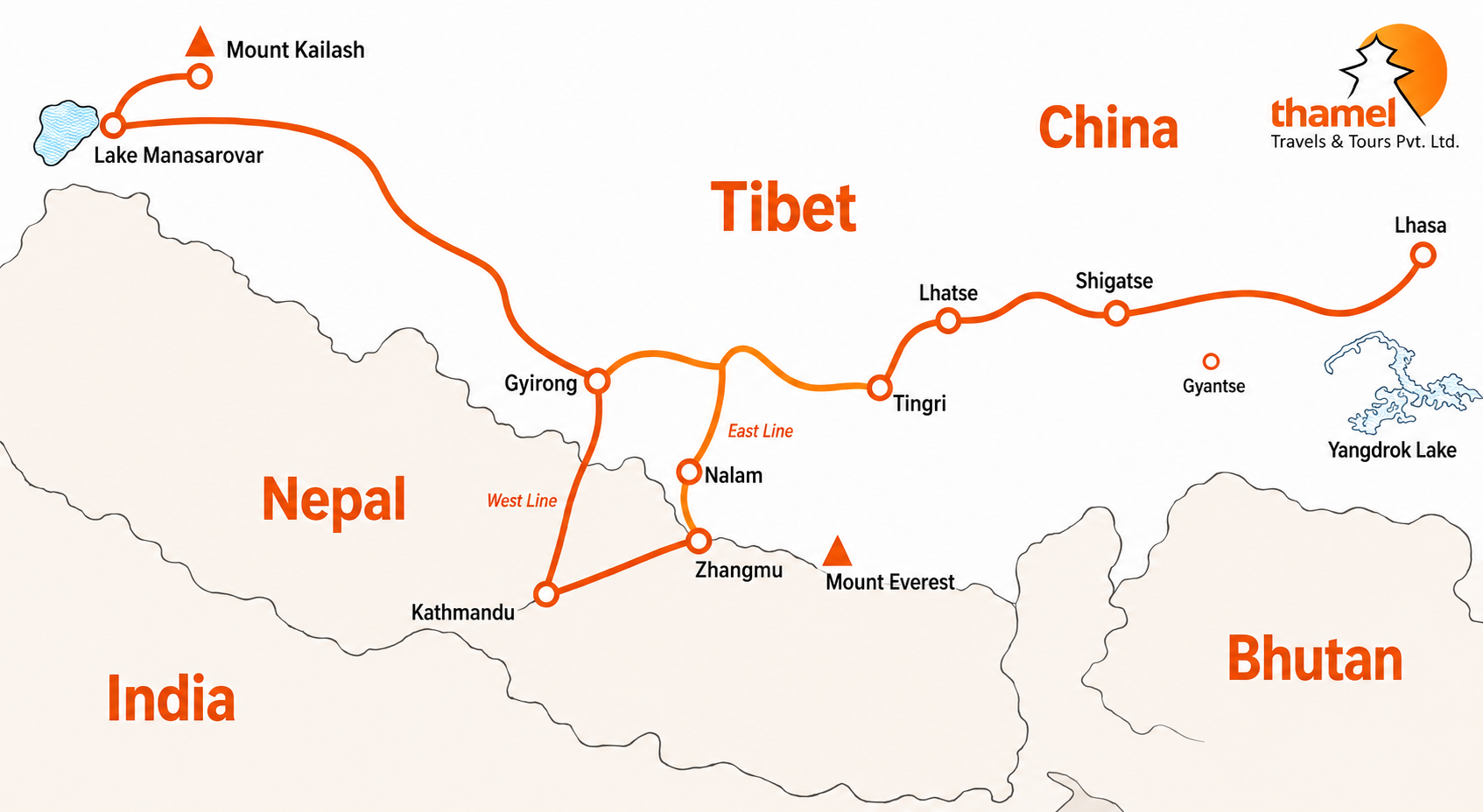
Lhasa Gonggar Airport is Tibet's main air gateway, with additional airports at Shigatse, Ngari (Kailash), and Nyingchi supporting regional travel. The Qinghai–Tibet Railway links Lhasa with Xining and the wider railway network across mainland China. From Nepal, Tibet can be reached by the Kathmandu–Lhasa flight or overland through the Kyirong (Rasuwagadhi–Gyirong) border crossing. Foreign visitors must obtain a Tibet Travel Permit and meet the current Chinese visa requirements, with travel arranged through a licensed travel agency.
Major Tourist Regions of Tibet
Region | Major Destinations | Best Known For | Popular Activities |
Lhasa | Potala Palace, Jokhang Temple, Barkhor Street, Norbulingka, Sera Monastery, Drepung Monastery | Tibetan Buddhism, UNESCO World Heritage Sites, traditional culture | Sightseeing, monastery visits, cultural tours |
Everest Region (Shigatse Prefecture) | Everest Base Camp (North), Rongbuk Monastery, Tingri | Northern face of Mount Everest, Himalayan scenery | Sightseeing, photography, overland adventure |
Mount Kailash & Lake Manasarovar (Ngari / Western Tibet) | Mount Kailash, Lake Manasarovar, Guge Kingdom, Tholing Monastery | Sacred pilgrimage, remote landscapes, ancient kingdoms | Kailash Kora trek, pilgrimage, jeep expeditions |
Central Tibet (Gyantse & Shigatse) | Tashilhunpo Monastery, Gyantse Kumbum, Pelkor Chöde Monastery, Yamdrok Lake | Historic monasteries, Tibetan heritage, scenic drives | Cultural tours, monastery visits, photography |
Nyingchi (Eastern Tibet) | Basum Lake, Yarlung Tsangpo Grand Canyon, Lulang Forest | Forested valleys, alpine scenery, mild climate | Nature tours, hiking, photography |
Shannan (Lhoka) | Samye Monastery, Yumbulagang Palace, Yarlung Valley | Birthplace of Tibetan civilisation, Tibet's first monastery | Cultural tours, heritage sightseeing |
Easily Accessible Tourist Destinations in Tibet
Destination | Accessibility | Best Known For | Suitable For |
Lhasa | Direct flights from Kathmandu (when operating) and major Chinese cities; Qinghai–Tibet Railway from Xining and other Chinese cities | Potala Palace, Jokhang Temple, Tibetan culture | All travellers |
Shigatse | About 4–5 hours by road or around 2–2.5 hours by high-speed train from Lhasa | Tashilhunpo Monastery, Tibet's second-largest city | Cultural travellers |
Gyantse | About 1.5–2 hours by road from Shigatse or 5–6 hours by road from Lhasa | Gyantse Kumbum, Pelkor Chöde Monastery, historic town | Cultural travellers |
Yamdrok Lake | About 2–3 hours by road from Lhasa | Sacred turquoise lake, mountain scenery | Couples, photographers, nature lovers |
Namtso Lake | About 4–5 hours by road from Lhasa (seasonal access, typically April–October) | High-altitude sacred lake, alpine scenery | Nature lovers, photographers |
Everest Base Camp (North) | Typically a 2-day overland journey from Lhasa via Shigatse | North face of Mount Everest, Rongbuk Monastery | Adventure travellers, photographers |
Mount Kailash & Lake Manasarovar | Typically a 3–4 day overland journey from Lhasa | Sacred pilgrimage, remote Himalayan landscapes | Pilgrims, spiritual seekers, adventure travellers |
Geographical Areas of Adventure Tourism
Adventure Region | Main Adventure Activities |
Everest Base Camp (North) | High-altitude overland expeditions, sightseeing, photography, short hikes |
Mount Kailash & Lake Manasarovar (Western Tibet) | Kailash Kora trek, pilgrimage, high-altitude trekking, overland expeditions |
Yarlung Tsangpo Grand Canyon (Nyingchi) | Trekking, hiking, nature exploration, photography |
Lhasa–Kathmandu Overland Route | Multi-day overland journey, mountain scenery, cultural sightseeing, photography |
Namtso Lake | Hiking, nature walks, photography |
Popular Tourist Destinations
Destination | Best Known For |
Lhasa | Potala Palace, Jokhang Temple, Tibetan Buddhist culture |
Mount Kailash & Lake Manasarovar | Sacred pilgrimage site for Buddhists, Hindus, and Bon followers |
Everest Base Camp (North side) | Views of Mount Everest from the Tibetan plateau |
Shigatse | Tashilhunpo Monastery |
Yamdrok & Namtso Lakes | Scenic sacred lakes |
Samye Monastery | Tibet's first Buddhist monastery |
Popular Tourist Routes
Lhasa – Gyantse – Shigatse – Everest Base Camp (North): Tibet's most popular overland journey, featuring the Potala Palace, Yamdrok Lake, Tashilhunpo Monastery, and spectacular views of the north face of Mount Everest.
Lhasa – Gyantse – Shigatse Cultural Circuit: A classic cultural route through Tibet's historic cities, ancient monasteries, sacred lakes, and traditional Tibetan towns.
Lhasa – Shigatse – Mount Kailash & Lake Manasarovar: A multi-day pilgrimage and adventure route to western Tibet, visiting Mount Kailash, Lake Manasarovar, and remote Himalayan landscapes.
Kathmandu – Lhasa Route (Flight or Overland): The main travel route between Nepal and Tibet, connecting Kathmandu with Lhasa by direct flight (when operating) or overland via the Kyirong (Rasuwagadhi–Gyirong) border crossing.
Top Spiritual Destinations in Tibet
Destination | Religious Significance |
Potala Palace, Lhasa | Former winter residence of the Dalai Lamas and a UNESCO World Heritage Site. |
Jokhang Temple, Lhasa | The most sacred temple in Tibetan Buddhism and an important pilgrimage site. |
Mount Kailash, Ngari | Sacred mountain for Buddhists, Hindus, Jains, and Bon followers; famous for the Kailash Kora pilgrimage. |
Lake Manasarovar, Ngari | Sacred lake associated with the Mount Kailash pilgrimage and revered in several religions. |
Tashilhunpo Monastery, Shigatse | Traditional seat of the Panchen Lama and one of Tibet's most important monasteries. |
Samye Monastery, Shannan (Lhoka) | Tibet's first Buddhist monastery, founded in the 8th century. |
Mount Everest: The World's Highest Peak
Standing at 8,848.86 metres, Mount Everest forms part of the border between Nepal and Tibet, with its northern face and North Base Camp located in the Everest region of Tingri County in the Tibet Autonomous Region. The Tibetan side offers road access close to Everest Base Camp, allowing travellers to experience spectacular views of the world's highest mountain without undertaking a multi-day trek. Many tours also include a visit to Rongbuk Monastery, one of the world's highest monasteries.
Mount Everest was first successfully climbed on 29 May 1953 by Sir Edmund Hillary and Tenzing Norgay. Today, climbers continue to attempt the summit from both the Nepal (south) and Tibet (north) sides during the spring climbing season.
Overall Government Policy on Tourism in Tibet
Tourism in the Tibet Autonomous Region operates under a controlled permit system rather than open independent travel. Foreign visitors must book through a licensed travel agency, travel with a licensed guide, obtain a Tibet Travel Permit, and meet the current Chinese entry requirements. Additional permits are required for destinations such as Everest Base Camp, Mount Kailash, and other restricted areas.
The permit system is intended to manage tourism, protect cultural and religious heritage, and help preserve Tibet's fragile high-altitude environment while ensuring travel is conducted in accordance with regional regulations.
Nepal's Connectivity with Tibet
Nepal is one of the two main international gateways to Tibet, alongside mainland China. Travellers can reach Lhasa from Kathmandu by direct flight (when operating) or overland through the Kyirong (Rasuwagadhi–Gyirong) border crossing. Foreign visitors must obtain a Tibet Travel Permit and meet the current Chinese entry requirements, with travel arranged in advance through a licensed Tibet travel agency.
Practicality of Touring Tibet with Nepal
Kathmandu is an important gateway for travellers combining Nepal and Tibet, with access to Lhasa by direct flight (when operating) or overland via the Kyirong (Rasuwagadhi–Gyirong) border crossing. As foreign visitors must obtain a Tibet Travel Permit, meet the current Chinese entry requirements, and travel through a licensed Tibet travel agency with a licensed guide, arranging the trip in advance is essential.
Thamel Travels and Tours organises combined Nepal–Tibet itineraries, assisting with permits, entry requirements, transport, accommodation, and licensed guides for journeys to Lhasa, Mount Kailash, Everest Base Camp (North), and other destinations across Tibet.