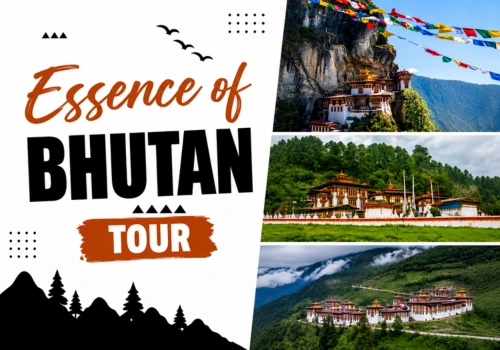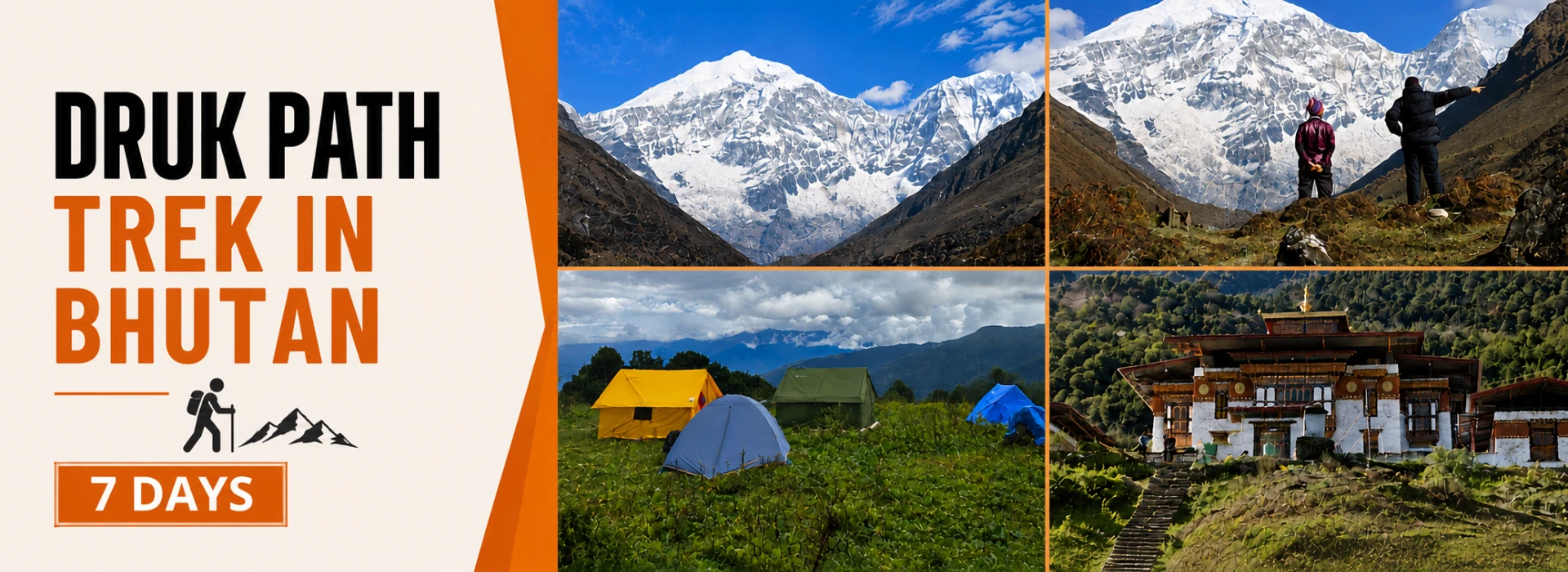
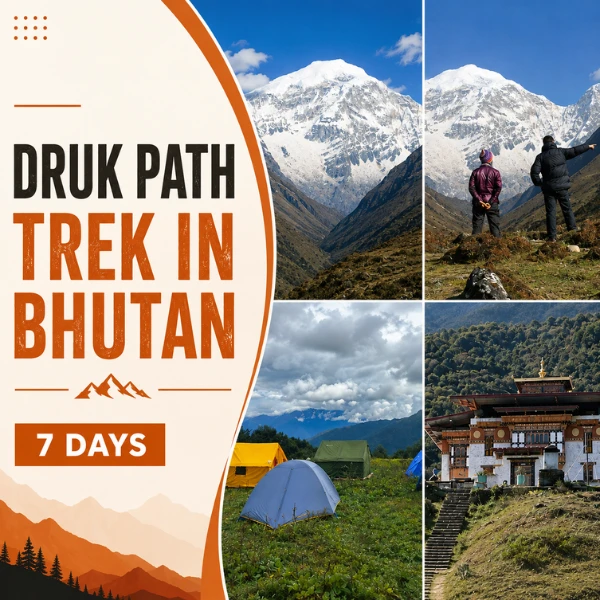
7 days Druk Path Trek from Paro to Thimphu with camping and alpine landscapes7 days Druk Path Trek from Paro to Thimphu with camping and alpine landscapes

Druk Path Trek Bhutan - 7 Days

  • Duration7 Days
  • Route Grade Exploratory Travel
  • Trip Style Private Guided Trekking & Camping Tour
  • Starting City Paro
  • Ending City Thimphu
Price fromUS$1975US$2150
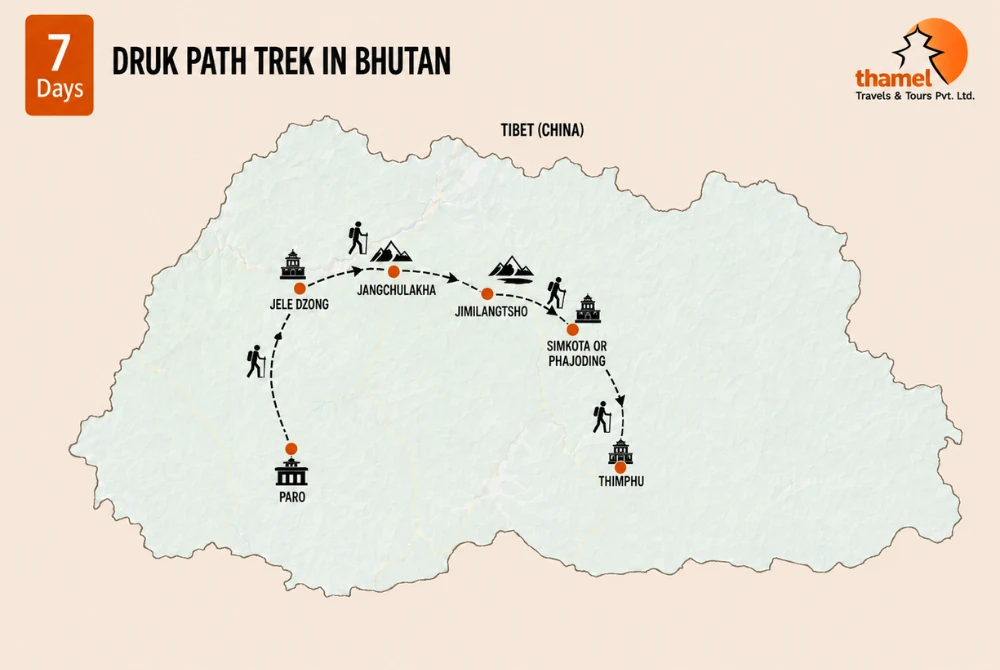
Druk Path Trek Bhutan - 7 Days map

Trip Overview

The Druk Path Trek Bhutan is a 7 day trekking journey connecting the valleys of Paro and Thimphu through Bhutan's most scenic highlands. This is a camping trek well enjoyed in a vintage style. The trek reaches approximately 4,200 m at its highest point, making it one of the most rewarding short treks in the Bhutanese Himalayas. It combines alpine forests, high mountain ridges and alpine lakes with traditional Bhutanese landscapes along the way.

The journey begins with a day of sightseeing in Paro before entering the Druk Path trail. Four days of trekking and camping follow, moving through forest, ridgeline and highland lake terrain. The trek ends with a descent from the Phajoding area into Thimphu.

The final day is spent exploring Bhutan's capital before departure. This combination of trekking and cultural sightseeing suits travelers seeking an active introduction to Bhutan. It offers a genuine Himalayan trekking experience without the time commitment of a longer multi week expedition.

Trip Detail

Information
Detail

Trip Code

BOT105N

Starting Point / End Point

Paro to Thimphu

Accommodation

3 star hotel in Paro and Thimphu, camping during the trekking days

Max Altitude

Approximately 4,200 m on the Druk Path route

Duration

7 Days, 6 Nights

Country

Bhutan

Trip Grade

Moderate, suitable for travelers with prior walking or hiking experience

Trip Style

Private, guided trek with camping crew, and support staff

Activities

Paro and Thimphu sightseeing, high altitude trekking, alpine lake and forest walks, camping

Trek Route 

Paro to Jele Dzong to Jangchulakha to Jimilangtsho to Simkota or Phajoding area to Thimphu

Season

Spring and autumn are generally the most favorable seasons for trekking

Transportation

Private vehicle for road transfers, on foot for the trekking days

Meals

All meals included throughout the trip

Itinerary Overview

This 7 day, 6 night journey pairs Bhutan's two most visited towns, Paro and Thimphu, with the Druk Path Trek, a four day trekking route that crosses the forested ridgeline separating the two valleys. It is designed for travelers who want to experience Bhutan's mountain landscapes while still having time for cultural sightseeing, the trek moves through pine forest near Jele Dzong, climbs through alpine woodland at Jangchulakha, and passes a chain of highland lakes at Jimilangtsho. It reaches its highest point in the Simkota and Phajoding area, at an elevation of approximately 4,200 m, before descending into Thimphu for a final day of sightseeing and departure.

Here is a quick look at how your journey unfolds.

  • Day 1: Arrive in Paro and spend the day exploring Kyichu Lhakhang, the National Museum and Paro town. Overnight hotel in Paro.

  • Day 2: Begin the Druk Path Trek from Paro toward Jele Dzong, with the first night of camping in the mountains.

  • Day 3: Trek from Jele Dzong to Jangchulakha through alpine forest with mountain views. Overnight camp.

  • Day 4: Trek from Jangchulakha to Jimilangtsho, passing highland scenery and alpine lakes. Overnight camp.

  • Day 5: Trek from Jimilangtsho to the Simkota or Phajoding area through high altitude landscapes. Overnight camp.

  • Day 6: Descend from the Phajoding area to Thimphu, check in to your hotel and enjoy a relaxed evening. Overnight hotel in Thimphu.

  • Day 7: Thimphu sightseeing followed by departure or onward journey.
     

Why You Will Love This Trip

  • A Classic Bhutan Trek: The Druk Path Trek is one of Bhutan’s best known short trekking routes, connecting Paro and Thimphu through mountain terrain. Over the trekking section, you spend 4 nights camping and reach elevations of around 4,200 m, making it a genuine Himalayan trekking experience within a 7 day journey.

  • Mountain Camping Experience: Enjoy 4 nights of camping along the Druk Path, with trekking support for your tents and meals. The camps are set in peaceful mountain surroundings, giving you a chance to experience Bhutan beyond its towns and hotels.

  • Paro and Thimphu Together: The journey combines Paro and Thimphu with the Druk Path trekking route between them. You begin with sightseeing around Paro, including Kyichu Lhakhang and the National Museum, before trekking toward Thimphu and exploring the capital after the trek.

  • Forests and Alpine Landscapes: The trail gradually changes from pine and rhododendron forests near Paro to open mountain terrain at higher elevations. Along the route, you pass through Jele Dzong and Jangchulakha, with changing views of ridges, valleys and surrounding Himalayan landscapes.

  • Jimilangtsho and Highland Lakes: Jimilangtsho is one of the major natural highlights of the trek. The trail reaches the lake after crossing highland terrain, with the peaceful lake surrounded by mountain scenery and alpine vegetation.

  • Jangchulakha Mountain Views: The Jangchulakha section offers a more open mountain landscape after the forested trails. From the higher ridges, clear weather can provide broad views across the surrounding Bhutanese mountains.

  • Phajoding and Thimphu Valley Views: On the descent toward Thimphu, the trail passes through Phajoding, a historic monastic and retreat area above the capital. The hillside provides views toward the Thimphu Valley before the trail continues down to the city.

  • A Moderate Himalayan Adventure: The Druk Path is a medium difficulty trek with a highest point of approximately 4,200 m. It is a good choice for reasonably fit travelers who want several days of genuine mountain trekking without committing to one of Bhutan’s longer expeditions.

  • Culture Before and After the Trek: The trek is balanced with cultural experiences in both Paro and Thimphu. Visit sites such as Kyichu Lhakhang and the National Museum in Paro, then finish the journey with sightseeing around Thimphu after completing the mountain trail.

  • A Great Seven Day Trekking Experience: This 7 Days / 6 Nights itinerary combines cultural sightseeing with 4 nights of mountain camping and trekking between Paro and Thimphu. It is a practical choice for travelers who want to experience Bhutan’s culture, highland landscapes, alpine lakes and Himalayan trails in one compact journey.
     

Altitude and Activities

The route moves between the Paro valley at approximately 2,200 m and a series of highland camps that rise toward the maximum altitude of approximately 4,200 m on the trek's higher stretches, before descending into Thimphu at approximately 2,320 m. Exact camp altitudes can vary slightly depending on route conditions, seasonal factors and the specific campsite used by the trekking crew on a given day.

Day
Location
Approximate Altitude
Activities
Trekking Distance / Time

Day 1

Paro

About 2,200 m

Arrival in Paro, sightseeing in Paro town

Local sightseeing within Paro

Day 2

Jele Dzong

Rising from about 2,200 m in Paro to the Jele Dzong campsite

Begin trek, forest trail, Jele Dzong

Approximately 8 km, 3 to 4 hours

Day 3

Jangchulakha

Alpine forest terrain on the ridgeline above Paro

Forest trail, mountain views

Approximately 10 km, 3 to 4 hours

Day 4

Jimilangtsho

Highland terrain near the alpine lakes

Alpine lakes, highland scenery

Approximately 11 km, 6 to 7 hours

Day 5

Simkota / Phajoding area

Highest point of the trek, approximately 4,200 m

High altitude landscapes

Approximately 11 km, 4 to 6 hours

Day 6

Thimphu

Descending to about 2,320 m in Thimphu

Descent to Thimphu, hotel check in

Descent trek followed by road transfer within Thimphu

Day 7

Thimphu

About 2,320 m

Thimphu sightseeing, departure

Local sightseeing within Thimphu

Accommodation and Meals

Your accommodation is arranged in 3 star hotels in Paro and Thimphu, with camping used during the trekking days between Day 2 and Day 5. The camping arrangement is fully supported, with a dedicated crew responsible for setting up and breaking down camp each day, so travelers only need to carry a day pack while trekking. All meals are included throughout the trip, with the trekking crew preparing breakfast, lunch and dinner at camp during the trekking days, and hotel restaurants providing meals in Paro and Thimphu.

Day
Location
Accommodation
Breakfast
Lunch
Dinner

Day 1

Paro

3 star hotel in Paro

N/A

N/A

Included

Day 2

Jele Dzong

Camping

Included

Included

Included

Day 3

Jangchulakha

Camping

Included

Included

Included

Day 4

Jimilangtsho

Camping

Included

Included

Included

Day 5

Simkota / Phajoding area

Camping

Included

Included

Included

Day 6

Thimphu

3 star hotel in Thimphu

Included

Included

Included

Day 7

Departure

N/A

Included

N/A

N/A

What to Expect on the Trail

  • Forest trails at the start: The first two trekking days move through pine forest, gradually shifting to rhododendron and juniper as the trail climbs higher toward the ridgeline.

  • A gentle first day: The walk from Paro to Jele Dzong is considered an easy introduction to the trek, giving your body time to begin adjusting to the altitude gain.

  • The longest trekking day: The stretch from Jangchulakha to Jimilangtsho covers about 11 km over 6 to 7 hours through highland terrain, making it the most demanding day on the route.

  • The highest point of the trek: The walk toward the Simkota or Phajoding area reaches approximately 4,200 m, crossing exposed ridgelines with some of the widest views of the trip.

  • Open ridgeline views: Beyond the tree line, the trail moves across highland pasture and ridges, offering broad mountain views across Bhutan on clear days.

  • Changing mountain weather: Conditions at higher elevations can shift quickly from clear skies to cloud, wind or rain, so layered clothing and a steady pace matter.

  • Camp set up ahead of you: The trekking crew moves ahead each day to pitch tents and prepare meals, so a hot meal and shelter are ready when you arrive at camp.

  • Cold nights at higher camps: Temperatures drop noticeably after sunset, particularly at the camps near Jimilangtsho and the Simkota or Phajoding area, so a warm sleeping bag is essential.
Cost Includes

Cost and Inclusions

This Druk Path Trek package includes 3 star hotel accommodation in Paro and Thimphu, camping accommodation and full trekking support during the trek, all meals throughout the trip, an experienced guide, all ground transfers, entrance fees at heritage sites on the itinerary and the Bhutan tourist visa fee. The table below outlines everything included in your package, along with the items you will need to arrange separately.

Cost Includes
Cost Excludes

Accommodation at 3 star hotels in Paro and Thimphu

International airfare to and from Bhutan

Camping accommodation during the trekking days

Any costs arising from flight delays or itinerary changes due to weather

All meals, breakfast, lunch and dinner, throughout the trip

Personal expenses such as drinks, laundry, shopping and phone calls

Experienced guide throughout the trip

Tips for guide, driver and trekking crew

All ground transfers in Paro and Thimphu

Travel insurance

Trekking support including camping crew and pack animals


Entrance fees at Kyichu Lhakhang, the National Museum and heritage sites on the itinerary


Bhutan tourist visa fee


Sustainable Development Fee (SDF), the mandatory nightly government fee

 
Itinerary

Welcome to Bhutan. Your guide will meet you outside the arrival terminal at Paro International Airport, holding a sign with your name. From here, spend the day exploring Paro at a relaxed pace, beginning with Kyichu Lhakhang, one of the oldest temples in the country and an important site of pilgrimage. Continue to the National Museum, housed in the old watchtower above Paro Dzong, which holds a wide collection of Bhutanese art, thangkas, ceremonial masks and historical artifacts that give useful context for the temples and dzongs you will see throughout the trip. In the afternoon, walk through Paro town, browsing local shops and getting your first feel of the valley before your trek begins the following day. This first day is kept unhurried, allowing time to settle in after your flight and make any final preparations for the trekking days ahead.

  • Route: Sightseeing within Paro

  • Distance: Local sightseeing within Paro

  • Altitude: About 2,200 m

  • Accommodation: 3 star hotel in Paro

  • Meals: Dinner

  • Highlights: Kyichu Lhakhang, National Museum, Paro town

    After breakfast, begin the Druk Path Trek. The trail leaves the Paro valley floor and climbs steadily through pine forest, gaining altitude gradually as it moves away from the roadhead. This first day is generally considered a gentle introduction to the trek, giving your body time to begin acclimatizing to the altitude gain before the more demanding days ahead. The trail eventually reaches Jele Dzong, a small dzong perched on a ridge above the valley, which on clear days offers views back down over Paro. Your trekking crew will have gone ahead to set up camp, so you arrive to find tents already pitched and a hot meal being prepared. This first night at camp, with the sound of the forest around you and the lights of Paro visible far below, is often remembered as one of the most striking moments of the trip.

    • Route: Paro to Jele Dzong

    • Distance: Approximately 8 km, 3 to 4 hours

    • Altitude: Rising from about 2,200 m in Paro to the Jele Dzong campsite

    • Accommodation: Camping

    • Meals: Breakfast, lunch and dinner

    • Highlights: Start of the Druk Path Trek, forest trail, Jele Dzong, first night camping

      After breakfast at camp, continue trekking from Jele Dzong to Jangchulakha. The trail moves through alpine forest along the ridgeline, with the vegetation gradually shifting from pine to dwarf rhododendron and juniper as you gain altitude. The path opens up periodically to wide mountain views on clear days, and this stretch of the trek is also known for the chance to spot local wildlife, including various pheasant species that inhabit the forest. The walking on this day is steady rather than steep, making it a good day to settle into the rhythm of trekking life, with regular breaks along the trail to take in the scenery. Camp is set up for the night at Jangchulakha, a highland pasture area used by yak herders during the summer months.

      • Route: Jele Dzong to Jangchulakha

      • Distance: Approximately 10 km, 3 to 4 hours

      • Altitude: Alpine forest terrain on the ridgeline above Paro

      • Accommodation: Camping

      • Meals: Breakfast, lunch and dinner

      • Highlights: Alpine forest trail, mountain views, possible wildlife sightings, Jangchulakha highland pasture

        After breakfast, trek from Jangchulakha to Jimilangtsho, one of the longer and more demanding days on the route. The trail moves through highland terrain toward a chain of alpine lakes, with Jimilangtsho among the most notable, its still waters reflecting the surrounding ridgelines on calm days. This stretch of trekking covers a greater distance and duration than the previous two days, and travelers should expect a longer day on the trail with the terrain becoming more exposed as you move further from the tree line. The reward for the extra effort is the setting at Jimilangtsho itself, a genuinely remote highland lake environment that few visitors to Bhutan ever see. Camp is set up near the lake for the night, and the area is known for being colder after sunset than the forested camps of the previous nights.

        • Route: Jangchulakha to Jimilangtsho

        • Distance: Approximately 11 km, 6 to 7 hours

        • Altitude: Highland terrain near the alpine lakes

        • Accommodation: Camping

        • Meals: Breakfast, lunch and dinner

        • Highlights: Alpine lakes, highland scenery, remote lake camp at Jimilangtsho

          After breakfast, continue trekking toward the Simkota or Phajoding area, reaching the highest point of the trek at approximately 4,200 m. This day covers genuinely high altitude terrain, with the trail crossing exposed ridgelines that offer some of the most expansive views of the entire trek on clear days, including distant Himalayan peaks depending on conditions. Given the altitude and distance covered, this is considered one of the more demanding days of the trek, and a steady pace with regular rest stops is recommended. Camp is set up in the Simkota or Phajoding area for the final night of trekking, marking the high point of the journey both literally and in terms of the trekking experience.

          • Route: Jimilangtsho to Simkota / Phajoding area

          • Distance: Approximately 11 km, 4 to 6 hours

          • Altitude: Highest point of the trek, approximately 4,200 m

          • Accommodation: Camping

          • Meals: Breakfast, lunch and dinner

          • Highlights: Highest point of the trek, high altitude landscapes, expansive ridgeline views

            After breakfast, descend from Phajoding toward Thimphu, bringing the trekking portion of the journey to a close. Phajoding itself is home to a cluster of monasteries and retreat huts that have served as a meditation retreat site for centuries, and depending on time and conditions, some of these may be visited on the way down. The descent is a welcome change of pace after the previous demanding days, with the trail dropping steadily through forest as Thimphu comes into view below. On reaching the roadhead, a private vehicle transfers you the short distance into Thimphu, where you check in to your hotel and take the evening to rest, shower and reflect on four days of trekking before returning to city comforts.

            • Route: Phajoding to Thimphu

            • Distance: Descent trek followed by road transfer within Thimphu

            • Altitude: Descending to about 2,320 m in Thimphu

            • Accommodation: 3 star hotel in Thimphu

            • Meals: Breakfast, lunch and dinner

            • Highlights: Descent from Phajoding, monasteries and retreat huts along the way, arrival in Thimphu

              After breakfast, spend time exploring Thimphu before your onward journey. Depending on your flight schedule, this may include a visit to Tashichho Dzong, the fortress and monastery that houses government offices and Bhutan's central monk body, or the Buddha Dordenma statue at the Kuensel Phodrang viewpoint, which looks out over the entire Thimphu valley. This final day gives you a chance to experience Bhutan's capital with fresh legs after the trek, before your guide takes you privately to the airport for your departure, closing your 7 day journey through the Paro valley, the Druk Path Trek and Thimphu.

              • Route: Sightseeing within Thimphu followed by transfer to the airport

              • Distance: Local sightseeing within Thimphu

              • Altitude: About 2,320 m

              • Meals: Breakfast

              • Highlights: Thimphu sightseeing, private airport transfer, departure from Bhutan

                Trip Information

                Know Before You Book

                • Bhutan Visa Requirements: All international tourists need a Bhutan visa arranged in advance through a licensed Bhutanese tour operator. Thamel Travels and Tours arranges this through our partner operator in Bhutan, and the visa fee is included in this package. Indian nationals travel on an entry permit instead of a visa, while Bangladeshi and Maldivian nationals can obtain their visa on arrival. Official details can be found at https://www.mfa.gov.bt/visa/

                • Sustainable Development Fee (SDF): Bhutan charges a Sustainable Development Fee, separate from the visa fee, as part of the country's High Value, Low Volume tourism policy. This fee is charged per person per night for the duration of your stay in Bhutan, including the nights spent camping during the trek. It is included in this package and processed together with your visa through our Bhutan partner operator.

                • Passport Validity: Please ensure your passport is valid for at least six months from your arrival date, with at least one blank page available for entry stamps.

                • Fitness Level: This trip is graded moderate. The main physical requirement is the four day Druk Path Trek, including a demanding day between Jangchulakha and Jimilangtsho and the high altitude stretch toward Simkota or Phajoding. Prior walking or hiking experience is recommended, and travelers with any underlying heart, lung or joint conditions should consult a doctor before booking. A reasonable base level of cardiovascular fitness will make the trekking days considerably more enjoyable.

                • Currency and Payment Methods: Bhutan uses the Ngultrum as its official currency, which is pegged to the Indian Rupee. The Indian Rupee is also widely accepted throughout the country. Major currencies such as USD, EUR and GBP can generally be exchanged at banks and authorized counters in Paro and Thimphu, though it is worth carrying some local currency in smaller denominations for personal expenses during the trekking days, when card payments are not possible.

                • Trekking Group Size: This trip is arranged as a private departure with your own guide, cook and camping crew, rather than joining a fixed group of unrelated travelers, allowing some flexibility in pace and daily timings.
                   

                Accommodation, Meals and Transportation

                • Accommodation: You will stay in 3 star hotels in Paro and Thimphu on Days 1 and 6, with camping arranged for the four nights of trekking between Day 2 and Day 5. Camping equipment, including sleeping tents, a dining tent and toilet tent, is provided by the trekking crew.

                • Meals: All meals, breakfast, lunch and dinner, are included throughout this 7 day Druk Path Trek journey. Meals in Paro and Thimphu are typically taken at the hotel or a nearby restaurant, while meals during the trekking days are prepared fresh at camp by the trekking cook.

                • Guide Support: A private, English speaking guide accompanies you throughout the trip, from airport pickup through to departure, including the full duration of the trek. A dedicated camping and trekking crew, including a cook and support staff, joins for the four trekking days, responsible for cooking, tent setup, breaking camp each morning and general trek logistics.

                • Transportation: This package includes private ground transfers in Paro and Thimphu, including airport pickup and drop off, along with all trekking logistics, including pack animals such as horses or mules for carrying camping equipment, food supplies and your personal duffel bag during the trek. International flights to and from Bhutan are not included, and travelers are responsible for arranging their own international airfare.
                   

                Seasonal and Weather Updates

                • Spring (March to May): Spring is generally a favorable period for the Druk Path Trek, with rhododendrons blooming along the forested stretches of the trail between Paro and Jangchulakha, and comfortable daytime trekking conditions. Nights at camp remain cold throughout this season, particularly at higher altitude campsites.

                • Summer (June to August): Summer brings the monsoon, with regular rainfall that can make trekking trails muddy and reduce visibility on the higher stretches of the route, particularly around Jimilangtsho and the Simkota or Phajoding area. Leeches can also be present on the lower forested sections of the trail during this period.

                • Autumn (September to November): Autumn is generally considered the most favorable season for the Druk Path Trek, with clear skies, stable weather and the best conditions for mountain views along the ridgeline sections of the route. This is typically the busiest season for trekking in Bhutan.

                • Winter (December to February): Winter brings cold temperatures and the possibility of snow at higher elevations along the trek, particularly near Jimilangtsho and the Simkota or Phajoding area. Snow can affect trail conditions on the higher stretches of the route and may require adjustments to the itinerary depending on conditions on the ground.
                   

                Health and Safety

                • General Wellbeing: The highest point of this trip is approximately 4,200 m, reached during the trekking days between Jimilangtsho and the Simkota or Phajoding area. Travelers should stay hydrated, walk at a comfortable pace, avoid overexertion on the ascents, and follow the guide's advice throughout the trek to manage the effects of altitude.

                • Healthcare Facilities: Basic medical facilities are available in Paro and Thimphu, with more comprehensive hospital facilities available in Thimphu, the capital. Medical support directly on the trekking route is limited to what the guide and crew can provide, so travelers should discuss any health concerns with their guide before departure and carry any personal medications required for the full duration of the trek.

                • Weather Awareness: Weather on the trekking route can change quickly, particularly at higher elevations near Jimilangtsho and the Simkota or Phajoding area, where conditions can shift from clear skies to cloud, wind or precipitation within a short period. Follow your guide's instructions closely in changing conditions.

                • Trail Conditions: The trekking route includes forest trails, exposed ridgelines and high altitude terrain, with trail conditions varying by season and recent weather, including the possibility of mud in summer and snow or ice in winter. Your guide and trekking crew will assess conditions daily and advise accordingly.

                • Altitude Acclimatization: Since the trek reaches altitudes considerably higher than either Paro or Thimphu, travelers should be attentive to any symptoms of altitude related discomfort, such as headache or unusual fatigue, and communicate these to the guide promptly so that pace or plans can be adjusted if needed.
                   

                Packing Checklist

                • Essential Clothing: Comfortable layered clothing suitable for cooler mountain days in Paro and Thimphu, along with warm layers for the trekking days and cold nights at camp, including a fleece or down jacket and thermal base layers for the higher campsites.

                • Footwear: Sturdy, broken in trekking shoes or boots suitable for forest trails, ridgeline walking and multiple consecutive days of trekking, along with a comfortable pair of camp shoes or sandals for evenings at camp.

                • Trekking Gear: A sleeping bag suitable for cold camp temperatures, trekking poles for the steeper and longer sections of trail, a headlamp with spare batteries, and a day pack for carrying personal items, water and layers during the trekking days.

                • Trail Gear: A sun hat, sunglasses, sunscreen and a rain jacket for changing weather on the trek, particularly on the exposed ridgeline sections between Jangchulakha and the Simkota or Phajoding area.

                • Personal Items: A reusable water bottle, personal toiletries, a camera, and any personal medications you need for the trekking days, along with a basic personal first aid kit including blister plasters and any regular prescription medication.

                • Cultural Note: Modest clothing covering shoulders and knees is expected when visiting religious sites such as Kyichu Lhakhang, Tashichho Dzong and any monasteries encountered along the trekking route, including those at Phajoding.
                   

                Important Notices

                • Travel Advisories: Before you travel, we recommend checking the latest travel advice issued by your home country regarding travel to Bhutan. Our team is happy to provide local updates before your trip departs.

                • Trekking Conditions: Trail and weather conditions on the Druk Path Trek can vary considerably by season. Your guide and trekking crew will assist with route decisions according to conditions on the day, and minor itinerary adjustments may be made where necessary for safety.

                • Flight Considerations: Paro International Airport is located in a mountainous area, and flight operations can occasionally be affected by weather conditions. Please plan your onward journey with some extra time in hand in case of delays.

                • Heritage Sites: Some monasteries, temples and dzongs, including Kyichu Lhakhang and Tashichho Dzong, may have specific visiting hours or restrictions depending on the day and any ongoing ceremonies. Your guide will assist with the visit according to local regulations.

                • Responsible Travel: We encourage you to respect local customs at religious sites throughout the journey, dress modestly, and follow your guide's advice on appropriate behavior on the trekking route and inside monasteries and dzongs, including at Phajoding.

                Trip Preparations
                • Do I need previous trekking experience for the Druk Path Trek?

                  Prior walking or hiking experience is recommended given the trek's moderate grading and the altitude reached on Day 5, but previous high altitude trekking experience is not required. Reasonably fit travelers who walk regularly at home generally manage the route well.

                • This is generally the most demanding day of the trek, covering approximately 11 km over 6 to 7 hours through highland terrain, so a reasonable level of fitness and a steady pace are recommended.

                • Your guide and trekking crew will assess conditions daily and may adjust the pace, timing or, in rare cases, the route where needed for safety. Camping equipment and crew support are arranged to manage typical mountain weather along the route, including rain and cold.

                • Since this is a private trip, days in Paro or Thimphu can be adjusted, and additional days or stops can be built into the itinerary if you would like more time to acclimatize before the trek or relax afterward.

                • Camping equipment including tents, cooking gear and trekking crew support is included in the package. Personal gear such as sleeping bags should be confirmed in advance with your operator and arranged if not already included.

                • Nights at camp can be significantly colder than daytime trekking temperatures, particularly at the higher camps near Jimilangtsho and the Simkota or Phajoding area, so warm layers and a suitably rated sleeping bag are important throughout the trek.