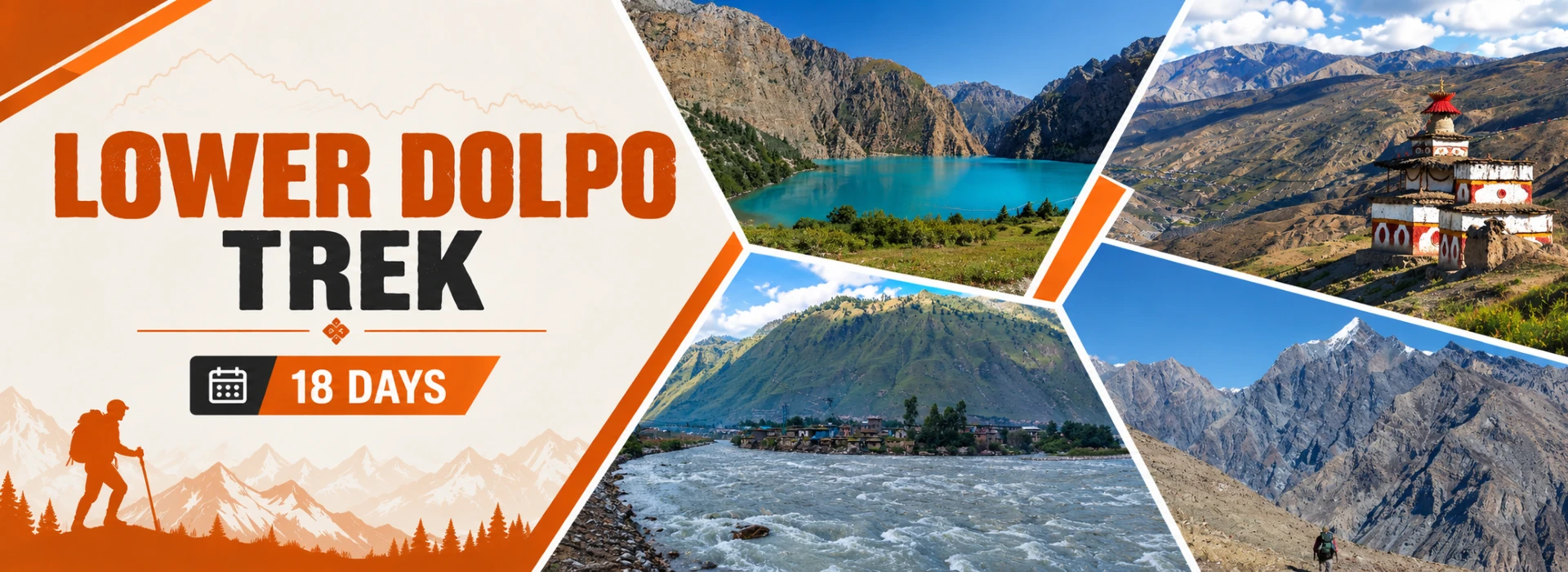
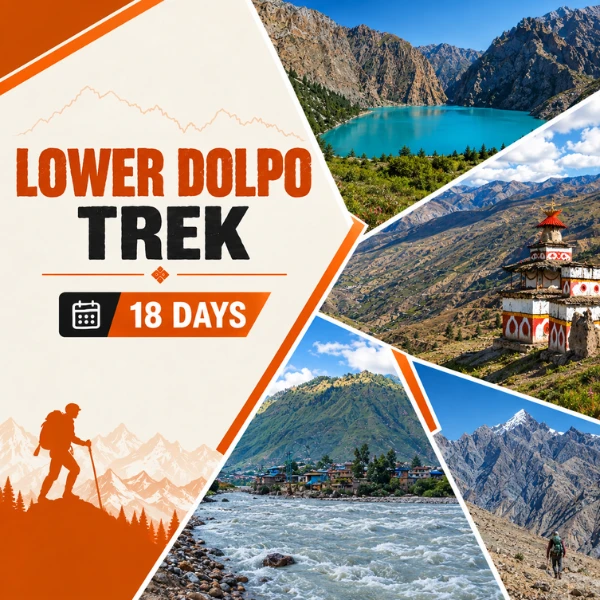
Lower Dolpo Trek with Phoksundo Lake and traditional Dolpo landscapesLower Dolpo Trek with Phoksundo Lake and traditional Dolpo landscapes

Lower Dolpo Trek - 18 Days

  • Duration18 Days
  • Route Grade Exploratory Travel
  • Trip Style Strenuous High Altitude Trek
  • Starting City Kathmandu
  • Ending City Kathmandu
Price fromUS$1525US$1575
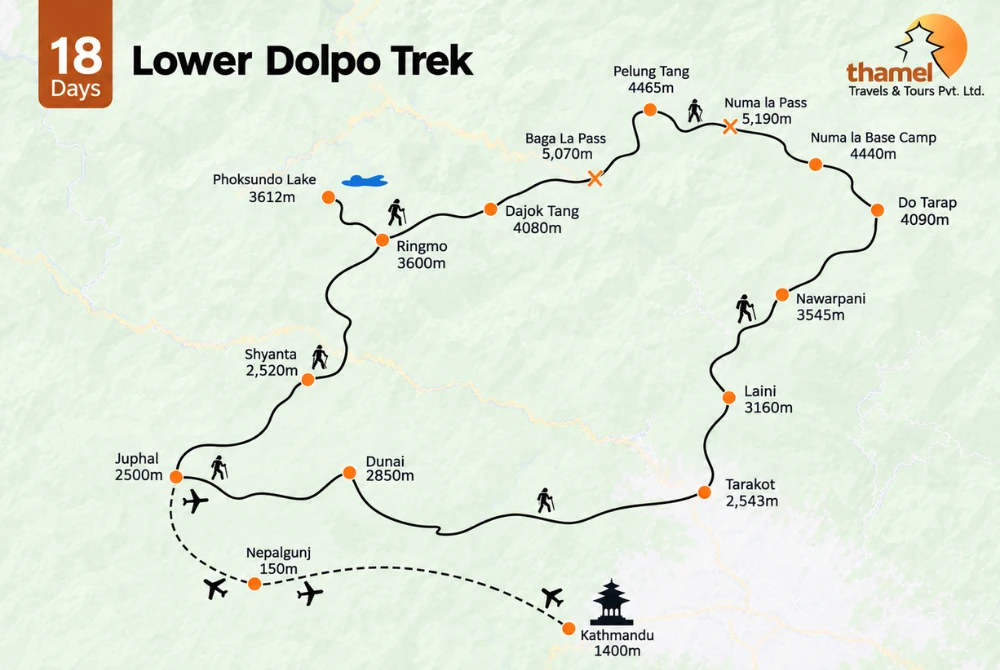
Lower Dolpo Trek - 18 Days map

Trip Overview

Lower Dolpo Trek  is a 18 days trip through Dho Tarap, Numa La, Baga La, Ringmo and Phoksundo Lake in the remote Dolpo region of Western Nepal. It is a strenuous high altitude trek through the remote Dolpa district of western Nepal. The journey takes you from Dunai through Tarakot, Laini, and Nawarpani to Dho Tarap, then across Numa La and Baga La passes to Ringmo Village and Phoksundo Lake. The route offers dramatic mountain scenery, remote Tibetan influenced villages, two high mountain passes, and Nepal's deepest lake.

This 18 day journey starts with flights from Kathmandu to Nepalgunj and Juphal before trekking through the valleys of the Dolpa district. The trek combines high mountain scenery with the unique culture and traditional lifestyle of the Dolpo people, Tibetan Buddhist and Bon monasteries, remote stone villages, and the turquoise waters of Phoksundo Lake inside Shey Phoksundo National Park.

Trip Detail

Information
Detail

Trip Code

WNT101N

Starting Point / End Point

Kathmandu to Kathmandu

Accommodations

4 star hotel in Kathmandu and Nepalgunj, teahouses where available during the trek, camping tents with full crew support where required

Max Altitude

5,190 m at Numa La Pass

Duration

18 Days, 17 Nights

Country

Nepal

Trip Grade

Strenuous, suitable for trekkers with good fitness and previous  high altitude trekking experience

Activities

Phoksundo Lake, Ringmo village, Dho Tarap valley, Numa La and Baga La pass crossings, Shey Phoksundo National Park

Season

Spring to Autumn (May to October)

Region

Dolpo region, Dolpa district, Shey Phoksundo National Park

Transportation

Domestic flight between Kathmandu and Nepalgunj, domestic flight between Nepalgunj and Juphal, trekking on foot for the rest of the route

Meals

Breakfast and dinner in Kathmandu and Nepalgunj, welcome dinner on Day 1, and farewell dinner near the end of the trip, full board meals during the trek.

Itinerary Overview

This 18 day trek begins with permit work and sightseeing in Kathmandu, then flights to Nepalgunj and Juphal to reach the trailhead at Dunai. From Dunai, the trail follows the Bheri and Barbung valleys through Tarakot, Laini, and Nawarpani to reach Dho Tarap. From Dho Tarap, the route climbs over Numa La Pass and Baga La Pass to Pelung Tang and Dajok Tang, then descends to Ringmo Village beside Phoksundo Lake. From the lake, the trail follows the Phoksundo Khola down through Shyanta back to Juphal, from where you fly back to Nepalgunj and Kathmandu.

Here is a quick look at how your 18 day trek unfolds.

  • Day 1: Arrival in Kathmandu at 1,400 m

  • Day 2: Trek permit preparation and sightseeing in Kathmandu

  • Day 3: Flight from Kathmandu to Nepalgunj at 150 m

  • Day 4: Flight from Nepalgunj to Juphal at about 2,500 m, trek to Dunai at about 2,850 m

  • Day 5: Trek from Dunai to Tarakot at 2,543 m

  • Day 6: Trek from Tarakot to Laini at 3,160 m

  • Day 7: Trek from Laini to Nawarpani at 3,545 m

  • Day 8: Trek from Nawarpani to Dho Tarap at 4,090 m

  • Day 9: Acclimatization day at Dho Tarap at 4,090 m

  • Day 10: Trek from Dho Tarap to Numa La Base Camp at 4,440 m

  • Day 11: Trek from Numa La Base Camp to Pelung Tang at 4,465 m via Numa La Pass at 5,190 m

  • Day 12: Trek from Pelung Tang to Dajok Tang at 4,080 m via Baga La Pass at 5,070 m

  • Day 13: Trek from Dajok Tang to Ringmo at 3,600 m

  • Day 14: Trek from Ringmo to Phoksundo Lake at 3,612 m

  • Day 15: Trek from Phoksundo Lake to Shyanta at 2,520 m

  • Day 16: Trek from Shyanta to Juphal at 2,500 m

  • Day 17: Flight from Juphal to Nepalgunj, then Nepalgunj to Kathmandu

  • Day 18: Final departure from Kathmandu

Lower Dolpo Trek Highlights

  • Cross two major mountain passes, Numa La at 5,190 m and Baga La at 5,070 m, while enjoying wide views of the remote mountains, valleys, and high Himalayan terrain of Dolpo.

  • Reach the beautiful Phoksundo Lake at 3,612 m, famous for its clear blue and turquoise water, steep surrounding cliffs, and dramatic Himalayan scenery within Shey Phoksundo National Park.

  • Explore Ringmo Village, a traditional Himalayan settlement near Phoksundo Lake, known for its stone houses, mani walls, local Buddhist culture, and the nearby monastery.

  • Experience Dho Tarap at 4,090 m, a high mountain settlement in the Tarap Valley where local communities have preserved their traditional way of life, culture, and religious practices.

  • Walk through the Tarap Valley and along the river valleys of Lower Dolpo, passing remote villages, cultivated fields, traditional houses, and rugged mountain landscapes.

  • Trek through Shey Phoksundo National Park, a remote protected area known for its diverse Himalayan landscape and wildlife, including blue sheep and other high altitude species.

  • Enjoy a combination of natural and cultural experiences, from high mountain passes and remote valleys to traditional villages, ancient religious traditions, and the remarkable landscape around Phoksundo Lake. 

  • Visit one of the least visited regions of Nepal, where trails see very few trekkers compared to the Everest and Annapurna regions
     

Key Destinations You Will Visit on the Lower Dolpo Trek

Dho Tarap and the Tarap Valley

Dho Tarap sits at about 4,090 m in a wide, open valley reached after several days of walking up the Barbung Khola from Tarakot. It is one of the highest permanent settlements in the world and is notable because Bon and Buddhist families live together in the same village, with separate monasteries within walking distance of each other. The local people, known as Dolpo pa, wear traditional woollen clothing and keep yaks and other livestock. Your rest day on Day 9 gives you time to explore the village, visit the monasteries, and walk through the surrounding fields before the climb toward Numa La Pass.

Numa La and Baga La Passes

These two passes form the physical and scenic heart of the Lower Dolpo Trek. Numa La, crossed on Day 11 at 5,190 m, is the higher of the two and the highest point of this itinerary, while Baga La, crossed on Day 12 at 5,070 m, follows soon after. Both crossings take you through remote alpine terrain with wide views over the Dolpa hills, and the two days that follow drop you steadily down toward Ringmo and Phoksundo Lake. Because the passes come back to back with only one camp at Pelung Tang between them, these two days are the most physically demanding part of the trek.

Ringmo Village and Phoksundo Lake

Phoksundo Lake is the deepest lake in Nepal, known for its clear turquoise water set against cliffs and forest inside Shey Phoksundo National Park. Ringmo, the traditional village beside the lake, has stone houses, mani walls, and a small Bon monastery. On this itinerary you reach Ringmo on Day 13 and continue to the lake itself on Day 14, giving you time in the area to walk along the shore and take in the surroundings before descending through the Phoksundo Khola valley toward Juphal.

Altitude and Activities

The trek begins in Kathmandu at 1,400 m before flying to Nepalgunj at 150 m and on to Juphal at about 2,500 m, the starting point for walking. From Juphal, the trail follows the Bheri and Barbung valleys through Tarakot, Laini, and Nawarpani, gaining height gradually to reach Dho Tarap at 4,090 m, where a rest day is scheduled. From Dho Tarap, the route climbs to Numa La Base Camp before crossing Numa La Pass at 5,190 m and Baga La Pass at 5,070 m on consecutive days, dropping to Ringmo Village and Phoksundo Lake. From the lake, the trail descends through Shyanta back to Juphal, from where you fly back to Kathmandu.

Day
Location
Altitude
Activities
Travel Time

Day 1

Kathmandu

1,400 m

Arrival and leisure time

Airport transfer

Day 2

Kathmandu

1,400 m

Permit processing and sightseeing

Full day in the city

Day 3

Nepalgunj

150 m

Flight from Kathmandu

About 1 hour

Day 4

Dunai

2,850 m

Flight to Juphal, then trek to Dunai

About 3 to 4 hours trekking

Day 5

Tarakot

2,543 m

Trek along the Bheri and Barbung valleys

About 5 to 6 hours

Day 6

Laini

3,160 m

Trek upstream along the Barbung Khola

About 5 to 6 hours

Day 7

Nawarpani

3,545 m

Trek through forested valley trail

About 5 to 6 hours

Day 8

Dho Tarap

4,090 m

Trek into the Tarap valley

About 6 to 7 hours

Day 9

Dho Tarap

4,090 m

Acclimatization day, optional village exploration

About 2 to 3 hours if hiking

Day 10

Numa La Base Camp

4,440 m

Trek toward the base of Numa La Pass

About 5 to 6 hours

Day 11

Pelung Tang

4,465 m

Cross Numa La Pass at 5,190 m

About 6 to 7 hours

Day 12

Dajok Tang

4,080 m

Cross Baga La Pass at 5,070 m

About 6 to 7 hours

Day 13

Ringmo

3,600 m

Trek down toward Ringmo village

About 5 to 6 hours

Day 14

Phoksundo Lake

3,612 m

Short trek to the lake shore, exploration

About 2 to 3 hours

Day 15

Shyanta

2,520 m

Trek down through the Phoksundo Khola valley

About 6 to 7 hours

Day 16

Juphal

2,500 m

Trek to the airstrip at Juphal

About 3 to 4 hours

Day 17

Kathmandu

1,400 m

Flight via Nepalgunj

About half a day of flying

Day 18

Departure

1,400 m

Final departure

Airport transfer

Accommodation and Meals

You will stay in a 4 star hotel in Kathmandu and Nepalgunj, with breakfast and dinner included on your Kathmandu and Nepalgunj days. Lunch is not included in Kathmandu or Nepalgunj, since these are free days meant for sightseeing, permit work, or rest, and you can choose your own place to eat lunch. Day 1 includes a welcome dinner, and your last evening in Kathmandu includes a farewell dinner. During the trek, you will stay in teahouses where available and in camping tents with full crew support elsewhere, with all three meals included every day.

Day
Location
Accommodation
Breakfast
Lunch
Dinner

Day 1

Kathmandu

4 star hotel

N/A

N/A

Welcome Dinner

Day 2

Kathmandu

4 star hotel

Included

Not Included

Included

Day 3

Nepalgunj

4 star hotel

Included

Not Included

Included

Day 4

Dunai

Teahouse or camping tent

Included

Included

Included

Day 5

Tarakot

Teahouse or camping tent

Included

Included

Included

Day 6

Laini

Teahouse or camping tent

Included

Included

Included

Day 7

Nawarpani

Teahouse or camping tent

Included

Included

Included

Day 8

Dho Tarap

Teahouse or camping tent

Included

Included

Included

Day 9

Dho Tarap

Teahouse or camping tent

Included

Included

Included

Day 10

Numa La Base Camp

Camping tent

Included

Included

Included

Day 11

Pelung Tang

Camping tent

Included

Included

Included

Day 12

Dajok Tang

Camping tent

Included

Included

Included

Day 13

Ringmo

Teahouse or camping tent

Included

Included

Included

Day 14

Phoksundo Lake

Teahouse or camping tent

Included

Included

Included

Day 15

Shyanta

Teahouse or camping tent

Included

Included

Included

Day 16

Juphal

Teahouse or camping tent

Included

Included

Included

Day 17

Kathmandu

4 star hotel

Included

Not Included

Included

Day 18

Departure

N/A

Included

N/A

N/A

Cost Includes

Cost and Inclusions

This 18 day trek includes accommodation in a 4 star hotel in Kathmandu and Nepalgunj, domestic flights between Kathmandu, Nepalgunj, and Juphal, required restricted area permits, an experienced licensed trekking guide, camping and kitchen crew support for sections without teahouses, and full board meals during the trek. The table below outlines what is included in your package and what you will need to arrange separately.

Cost Includes
Cost Excludes

Private airport arrival and departure transfers

International airfare to and from Nepal

4 star hotel accommodation in Kathmandu and Nepalgunj with breakfast and dinner

Nepal entry visa fee

Welcome dinner on Day 1 and farewell dinner near the end of the trip

Travel insurance

Domestic flights between Kathmandu, Nepalgunj, and Juphal, and the return sector

Tips for guide, porters, and kitchen crew

Teahouse or camping accommodation throughout the trek

Personal expenses such as drinks, snacks, and phone or internet charges

Full board meals, breakfast, lunch, and dinner, during the trek

Lunch in Kathmandu and Nepalgunj

Lower Dolpo restricted area permit and Shey Phoksundo National Park entry permit

Extra nights in Kathmandu or Nepalgunj due to flight delays

Experienced licensed trekking guide


Camping crew, cook, and kitchen staff for sections without teahouses


Porter service to carry trekking luggage

 
Itinerary

Welcome to Nepal. Once you land at Tribhuvan International Airport in Kathmandu, our representative will meet you right outside the arrival terminal holding a board with our company name and logo. They will take you to your hotel so you can check in and rest after your flight. The rest of the day is free for you to relax or walk around nearby. In the evening, our guide will meet you for a trek briefing, followed by a welcome dinner where you can meet the rest of your group.

  • Route: Tribhuvan International Airport to Hotel in Kathmandu

  • Altitude: 1,400 m

  • Accommodation: 4 star hotel

  • Meals: Welcome Dinner

  • Highlights: Arrival in Nepal, airport transfer, hotel check in, and trek briefing

    Today your guide and our office team will complete the paperwork for your Lower Dolpo restricted area permit and your Shey Phoksundo National Park entry permit. This work is done through our trekking agency and the government offices in Kathmandu, and you may need to hand over your passport copies and photos for this process. Once the permit process is underway, you will visit some of Kathmandu's famous cultural and historical sites, including Swayambhunath Stupa, Kathmandu Durbar Square, and Boudhanath Stupa. You will also have time to check your trekking gear and buy anything you may still need before the trek.

    • Route: Permit offices and sightseeing around Kathmandu

    • Altitude: 1,400 m

    • Accommodation: 4 star hotel

    • Meals: Breakfast and dinner

    • Highlights: Restricted area permit processing, Swayambhunath Stupa, Kathmandu Durbar Square, Boudhanath Stupa, and final gear check

      You will take a short domestic flight from Kathmandu to Nepalgunj, a city in the flat Terai region near the border with India. Nepalgunj is simply a stop on the way to the mountains, since the flight to Juphal leaves from here early the next morning. You will notice that the weather is warmer and more humid than in Kathmandu. The rest of the day is free at your hotel to rest before the mountain flight ahead.

      • Route: Kathmandu to Nepalgunj by domestic flight

      • Altitude: 150 m

      • Accommodation: 4 star hotel

      • Meals: Breakfast and dinner

      • Highlights: Domestic flight to the Terai lowlands, overnight stop before the flight to Juphal

        An early morning flight takes you from Nepalgunj into the mountains, landing on the small airstrip at Juphal. This is where the real trekking begins. From Juphal, the trail drops down and follows a path above the Thuli Bheri River. The walk today is short and gentle, giving you time to settle in after two flights before you reach Dunai, the main town of the Dolpa district, by the afternoon.

        • Route: Nepalgunj to Juphal by domestic flight, then trek to Dunai

        • Altitude: About 2,500 m at Juphal, reaching about 2,850 m at Dunai

        • Accommodation: Teahouse or camping tent

        • Meals: Breakfast, lunch, and dinner

        • Highlights: Mountain flight into Juphal, first day of trekking, arrival in Dunai

          Leaving Dunai, the trail follows the Bheri valley before turning to follow the Barbung Khola upstream toward Tarakot. You will walk through a mix of farmland and riverside trail, passing small settlements typical of the lower Dolpa district. Tarakot is an old village set above the river, known for its historic fort like setting and the nearby Sandul Gompa. This is an easier day compared to the walking that follows, and gives you a first proper look at rural Dolpa life.

          • Route: Dunai to Tarakot along the Bheri and Barbung valleys

          • Altitude: 2,543 m

          • Accommodation: Teahouse or camping tent

          • Meals: Breakfast, lunch, and dinner

          • Highlights: Walking through Dolpa farming villages, views of the historic Tarakot settlement

            Today the trail continues upstream along the Barbung Khola, moving through a mix of forest and terraced hillside. The valley gradually narrows as you gain height, and the trail becomes quieter with fewer villages along the way. Laini is a simple stop set in a more remote stretch of the valley, marking the start of the climb toward the higher Tarap region.

            • Route: Tarakot to Laini along the Barbung Khola

            • Altitude: 3,160 m

            • Accommodation: Teahouse or camping tent

            • Meals: Breakfast, lunch, and dinner

            • Highlights: Forested trail along the Barbung Khola, increasingly remote surroundings

              The trail keeps following the Barbung Khola upstream through forested hillside and narrow sections of trail cut into the valley wall. The surroundings grow steadily wilder as you climb, with fewer signs of permanent settlement. Nawarpani is a quiet riverside stop that serves as the last main camp before the climb into the open Tarap valley.

              • Route: Laini to Nawarpani along the Barbung Khola

              • Altitude: 3,545 m

              • Accommodation: Teahouse or camping tent

              • Meals: Breakfast, lunch, and dinner

              • Highlights: Continued valley walking, approach to the Tarap region

                The trail climbs out of the forested lower valley and gradually opens into the wide Tarap valley. Along the way you will pass villages that show the mixed Bon and Buddhist heritage of the Dolpo people, along with mani walls and chortens marking the trail. Dho Tarap itself sits in a broad, high altitude valley and is known as one of the highest permanent settlements in the world. Reaching Dho Tarap also marks the point where the trail begins climbing more seriously toward the high passes ahead.

                • Route: Nawarpani to Dho Tarap through the Tarap valley

                • Altitude: 4,090 m

                • Accommodation: Teahouse or camping tent

                • Meals: Breakfast, lunch, and dinner

                • Highlights: Entering the Tarap valley, first views of Dho Tarap village

                  This is a full rest day at Dho Tarap, planned to help your body adjust to the altitude before the climb toward Numa La Pass. It is better not to spend the whole day resting in your room or tent. A short walk to the village monasteries or through the surrounding barley fields is a good way to aid acclimatization while learning more about local Dolpo life. Many trekkers also use this day to observe the daily routines of the Dho Tarap community.

                  • Route: Acclimatization day around Dho Tarap

                  • Altitude: 4,090 m

                  • Accommodation: Teahouse or camping tent

                  • Meals: Breakfast, lunch, and dinner

                  • Highlights: Rest and acclimatization, exploring Dho Tarap village and its monasteries

                    Leaving Dho Tarap, the trail climbs steadily out of the valley into increasingly bare, high altitude terrain. Trees and shrubs thin out as you gain height, and the landscape turns rocky and open. This camp sits below Numa La Pass and marks your final stop before tomorrow's demanding crossing, so the pace today is kept steady to help with acclimatization.

                    • Route: Dho Tarap to Numa La Base Camp

                    • Altitude: 4,440 m

                    • Accommodation: Camping tent

                    • Meals: Breakfast, lunch, and dinner

                    • Highlights: Approaching the high alpine zone, preparation for the Numa La Pass crossing

                      This is one of the most demanding days of the trek, crossing Numa La Pass at 5,190 m, the highest point of the entire trip. You will start early, since the trail is easier to walk while the ground is still frozen and firm. From the top of the pass, clear weather offers wide views across the remote hills of the Dolpa district. After a short rest at the top, the trail descends into more sheltered ground toward the camp at Pelung Tang.

                      • Route: Numa La Base Camp to Pelung Tang via Numa La Pass

                      • Altitude: 5,190 m at the pass, dropping to 4,465 m at Pelung Tang

                      • Accommodation: Camping tent

                      • Meals: Breakfast, lunch, and dinner

                      • Highlights: Crossing Numa La Pass, the highest point of the trek

                        A second high pass, Baga La at 5,070 m, is crossed today, coming soon after yesterday's climb over Numa La. The early stretch of trail climbs steadily to the top of the pass, where you can look back across the ground you have already covered. From the pass, the trail drops down toward Dajok Tang, bringing you closer to the greener terrain around Phoksundo Lake.

                        • Route: Pelung Tang to Dajok Tang via Baga La Pass

                        • Altitude: 5,070 m at the pass, dropping to 4,080 m at Dajok Tang

                        • Accommodation: Camping tent

                        • Meals: Breakfast, lunch, and dinner

                        • Highlights: Crossing Baga La Pass, the second high pass of the trek

                          The trail continues to lose height as it moves from Dajok Tang toward Ringmo, with the surroundings turning noticeably greener after the bare, high altitude ground of the two pass crossings. Ringmo is a traditional stone village with mani walls and a small Bon monastery, set close to the shore of Phoksundo Lake. Arriving here brings you back into a more settled part of the Dolpa district after several remote camping days.

                          • Route: Dajok Tang to Ringmo

                          • Altitude: 3,600 m

                          • Accommodation: Teahouse or camping tent

                          • Meals: Breakfast, lunch, and dinner

                          • Highlights: Descending toward Ringmo village, first views of the Phoksundo valley

                            A short walk from Ringmo brings you to the shore of Phoksundo Lake, the deepest lake in Nepal, set inside Shey Phoksundo National Park. The lake is known for its striking turquoise colour, framed by cliffs, forest, and distant peaks. Since the walking distance is short today, you will have extra time to explore the lake shore and take in the surroundings at a relaxed pace.

                            • Route: Ringmo to Phoksundo Lake

                            • Altitude: 3,612 m

                            • Accommodation: Teahouse or camping tent

                            • Meals: Breakfast, lunch, and dinner

                            • Highlights: Arrival at Phoksundo Lake, time to explore the lake shore

                              Leaving the lake, the trail follows the Phoksundo Khola downstream through forested hillside, losing height steadily as you head back toward Juphal. The surroundings become greener and warmer as you descend, a clear contrast to the high, dry terrain crossed over the past several days. Shyanta is a quiet stop along this descending stretch of trail.

                              • Route: Phoksundo Lake to Shyanta along the Phoksundo Khola

                              • Altitude: 2,520 m

                              • Accommodation: Teahouse or camping tent

                              • Meals: Breakfast, lunch, and dinner

                              • Highlights: Descending through the forested Phoksundo Khola valley

                                Your final trekking day retraces part of the route back toward Juphal, where the walking section of the trip began. This shorter, easier day brings the trekking part of the journey to a close, ready for the flight out the next morning.

                                • Route: Shyanta to Juphal

                                • Altitude: 2,500 m

                                • Accommodation: Teahouse or camping tent

                                • Meals: Breakfast, lunch, and dinner

                                • Highlights: Final trekking day, arrival back at the Juphal airstrip

                                  An early flight takes you from Juphal back to Nepalgunj, followed by a connecting flight the same day to Kathmandu. Mountain flights in this region can sometimes be delayed by weather, so it is wise to keep the day flexible if possible. You will spend the evening back in your Kathmandu hotel, marking the end of the remote part of your trip.

                                  • Route: Juphal to Nepalgunj to Kathmandu by domestic flight

                                  • Altitude: 1,400 m

                                  • Accommodation: 4 star hotel

                                  • Meals: Breakfast and dinner

                                  • Highlights: Return flights to Kathmandu, end of the remote trekking section

                                    On your last day, after breakfast at the hotel, our representative will take you to Tribhuvan International Airport in good time for your international flight home. This brings your Lower Dolpo Trek to an end.

                                    • Route: Hotel in Kathmandu to Tribhuvan International Airport

                                    • Altitude: 1,400 m

                                    • Meals: Breakfast

                                    • Highlights: Airport transfer and final departure from Nepal

                                      Trip Information

                                      Know Before You Book

                                      • Visa Requirements: All citizens of the world except Indian passport holders need a visa to enter Nepal, and most travellers can obtain a Visa on Arrival at Tribhuvan International Airport. For this 18 day trip, a 30 day tourist visa is sufficient and costs USD 50. You can apply and pay online in advance at https://nepaliport-new.immigration.gov.np/

                                      • Passport Validity: Your passport should be valid for at least six months from your arrival date, with at least one blank page free for your visa stamp.

                                      • Restricted Area Permit: Lower Dolpo is a government restricted area. Trekking here requires a Lower Dolpo Restricted Area Permit, priced at USD 20 per person for the first week, with an additional USD 5 per person for each day beyond the first week, along with a Shey Phoksundo National Park entry permit priced at about NPR 3,000 per person. These are arranged by our agency through the Department of Immigration and a licensed guide must be with you at all times. Since fees are reviewed periodically by the Nepal government, please confirm the current cost with our office when you book. Permit details: https://immigration.gov.np/trekking-route-and-permit-fee 

                                      • Fitness Level: This trek crosses two passes above 5,000 m over more than two weeks of continuous walking in a remote setting. You should have good fitness and some experience with multiple day trekking before joining this trip.

                                      • Flight Reliability: Flights to and from Juphal depend on clear weather and can be delayed at short notice. We recommend building some flexible days into your travel plans, especially around Day 4 and Day 17.

                                      • Group and Guide Requirements: A licensed guide is required throughout the Lower Dolpo region, and additional local rules may apply regarding group registration, which our agency will manage on your behalf.

                                      • Travel Insurance: Since this region is remote with limited medical support, travel insurance that covers high altitude evacuation, medical emergencies, and trip delays is strongly recommended.

                                      • Currency and Payment Methods: We accept payment in major currencies such as USD, EUR, and GBP. Please carry enough Nepali Rupees for your personal spending, since there are no ATMs or banks once you leave Nepalgunj.
                                         

                                      Accommodations, Meals, and Transportation

                                      • Typical Accommodation Used: You will stay in a comfortable 4 star hotel in Kathmandu and Nepalgunj before and after the trek. During the trekking days, you will stay in teahouses where they exist along the route and in camping tents with a full support crew in the more remote parts of Dolpo where teahouses are not available.

                                      • Meals: Breakfast and dinner are included on all your Kathmandu and Nepalgunj days, with lunch left free for you to arrange, since these are sightseeing, permit, or rest days. A welcome dinner is included on Day 1, and a farewell dinner is included near the end of your trip. During the trek, all three meals are included every day, cooked fresh on site by our dedicated kitchen crew on the camping sections.

                                      • Guide Support: An experienced licensed guide travels with you for the whole trek, handling permits, route finding, and acclimatization, including both pass crossings at Numa La and Baga La. Porters carry the group and camping equipment, and a separate cook and kitchen team manage meals on the camping sections of the route.

                                      • Transportation: This package includes private airport transfers in Kathmandu, a domestic flight between Kathmandu and Nepalgunj, and a domestic flight between Nepalgunj and Juphal, along with the return sector at the end of the trek. All movement through the Dolpo region itself is done on foot.
                                         

                                      Seasonal and Weather Updates

                                      • Spring (March to May): This period offers improving conditions as winter snow clears from the passes, with generally settled weather through the trek.

                                      • Summer and Monsoon (June to August): Dolpo sits in the rain shadow of the main Himalayan range, so it receives much less monsoon rain than most of Nepal, though trail and pass conditions should still be checked closely during this period.

                                      • Autumn (September to October): This is generally regarded as one of the most favourable seasons for Lower Dolpo, with settled weather for the pass crossings, though nights at higher camps remain cold.
                                         

                                      Health and Safety

                                      • General Wellbeing: This trek spends an extended period above 3,500 m and crosses two passes above 5,000 m. You should know the signs of altitude sickness and tell your guide right away if you notice any symptoms.

                                      • Healthcare Facilities: Medical care inside the Dolpa district is limited, with only basic health posts in the larger villages. Full hospital care is available in Nepalgunj and Kathmandu. Your guide carries a basic first aid kit and can arrange emergency evacuation if needed.

                                      • Pacing: The rest day built into this trip at Dho Tarap is an important part of adjusting safely to the altitude before the Numa La and Baga La pass crossings.

                                      • Hydration: Drink plenty of fluids on every trekking day, and especially on the days when you cross a pass.

                                      • Weather Awareness: Weather at the high passes can change quickly. Always follow your guide's instructions about the timing of pass crossings and any changes to the day's plan.
                                         

                                      Packing Checklist

                                      • Essential Clothing: Warm, layered clothing suitable for many days at high altitude, including a good down jacket for cold mornings, evenings, and the pass crossings.

                                      • Footwear: Sturdy trekking boots with strong ankle support and good grip, able to handle many days of walking on varied and high altitude ground.

                                      • Trail Gear: A sun hat, sunglasses, sunscreen, and a rain jacket for changing weather, along with trekking poles for the pass crossings and steep descents.

                                      • Personal Items: A small daypack, a reusable water bottle, personal toiletries, a camera, a headlamp, any personal medicines you need, and a warm sleeping bag suitable for cold camping nights.
                                         

                                      Important Notices

                                      • Travel Advisories: Please check the latest travel advice from your home country before you travel. Our team can share local updates closer to your trip date.

                                      • Remote Terrain: This trek passes through remote parts of Nepal, with very few shops, no ATM facilities, and limited phone or internet coverage once you leave Nepalgunj. Please carry enough cash for the full trekking part of your trip.

                                      • Responsible Travel: Please respect local customs, ask before photographing monks or local families, and support the local economy of the Dolpa district during your visit.

                                      Trip Preparations
                                      • What is the highest point of the Lower Dolpo Trek?

                                        The highest point is Numa La Pass at 5,190 m, crossed on Day 11 of this itinerary.

                                      • Both. Teahouses are used where available, and camping with a full cook and kitchen crew is used in the more remote sections where teahouse facilities are limited.

                                      • Yes. Lower Dolpo is a restricted area, so you need a Lower Dolpo Restricted Area Permit along with a Shey Phoksundo National Park entry permit, both arranged through a licensed trekking agency, and a licensed guide must travel with you at all times.

                                      • One rest day is included, at Dho Tarap on Day 9, ahead of the Numa La and Baga La pass crossings.

                                      • Yes. The trail reaches Ringmo village on Day 13 and Phoksundo Lake on Day 14, giving you time at Nepal's deepest lake before the descent to Juphal.

                                      • The Lower Dolpo Trek is generally considered somewhat less demanding than the Upper Dolpo Trek, since it is shorter and involves two high passes rather than three, though it still requires good fitness and prior high altitude trekking experience.

                                      Similar Trips